Terapia Intensiva, Policlinico Umberto I, Roma. 10 January 2019.
The bearded doctor doing the rounds is everything I’m not: young, healthy and fit. In English, he introduces himself as ‘Dr Fox’* and that’s all I take in. But everything else he says sounds positive, I think.
The ward is no longer sunny and blue and there is something autumnal about the place. The floor has closed over so I can’t see the library anymore. There is no sign of ‘the German’, or the priest, or the ‘young Ronaldo’. I am more aware of the activity around the other beds than before and I watch a young nurse, busying herself around an unseen patient in the far corner. Beyond my toes, there is a male nurse with big glasses who seems amiable, but he’s like that restaurant waiter who won’t take the hint and come to your table. When I catch his eye, he smiles, and then returns to his tasks.
I have more sense of my body, too; of my head lying on a pillow; of the oxygen mask that covers my nose and thirsty mouth. I am strong enough, just, to reach the mask with my right hand and lift it away from my face. I let it ping back, then lift it again. It seems to make no difference to my breathing. I drag the mask below my lips. Maybe someone will hear me now.
I have a go: ‘Acqua, per favore’, I call, loudly enough for me to hear, at least.
Nothing happens.
I try again, and several times more. Still nothing happens, and I’m resigned to nothing ever happening when –
‘Jeremy?’
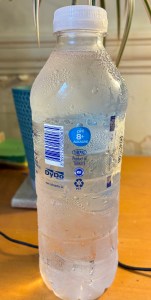
From the corner, the nurse is coming to me. Hearing my name out loud cuts through everything: the hiss and bubble of my oxygen supply, the beeps of machines, my own brain fog. It seems to come from another time and place. She comes close and I ask again. Then she leaves my bedside and heads to the main desk. I’m about to lose hope, but then she returns with a cold bottle of Evian. She removes the cap from the bottle and supports my back as I move towards it. She offers me of the water, and I do drink. And drink some more. And yes, the water is cold. And yes, it’s everything I’ve been longing for and yes, it banishes that awful dryness from my mouth. But more than that, the connection to water and another human being conducts me, of only briefly, back to three-dimensional life, instead of watching hazy footage of the world from way, way back.
I pause for breath and I expect her to take the water away. But she stays and I take another long gulp and I keep on until the bottle is drained. Then she resettles me on my pillows and without comment replaces my oxygen mask in its proper position.
The young nurse returns to her corner: she seems to be permanently needed there. For the first time, I think I glimpse the head of her patient. I’m still in the room, though I can feel myself retreating, and I lie back and watch the to and fro of the nurses and auxiliary staff. For a moment, I sense the power of their common purpose: to do their very best for those at their very worst, and to keep on doing so to keep them alive. I lack the resources to find a word for that power. So I call it love, because right now the air seems thick with it.
* * *
‘Hello.’
L is at my bed side, smiling wryly, and while I think I’ve heard her before, it’s the first time I’ve seen her since everything went dark however long ago. Her voice reduces the background burble and hiss, and suddenly the light in the ward has the fluorescence of a school hall.
She asks me how long I think I’ve been here, what day it is.
I remember that I arrived on a Friday evening.
Sunday? I venture.
Thursday.
Six days? I find this difficult to process.
She tells me that I’m in ICU. I’ve had sepsis, she says, but that it’s under control now, and that I’m getting better.
Sepsis? A familiar word but right then I’m not sure what it means. But I know it’s much worse than flu, and worse than the UTI suspected by the paramedics. No wonder I felt so grim.
L tells me that because I’m going to be here for a while, the kids have come back to Rome.
When she has gone, I think about the missing six days. Losing time in this way is entirely new to me. There are knock-on effects to my medications and addictions. Six days without my 20mg dose of escitalopram. Six days without coffee. And the last time I went this long without a cigarette was in 1983. I’m too weak to crave anything – apart from water – but I do wonder how long this enforced abstinence will last.
The penny drops: nothing will change soon because I’m in intensive care, which is for people who are really sick. But although I am too weak to move much, have a pain in my left knee and a curious browning of the skin on my right hand, I don’t feel as if I have any symptoms.
* * *
Terapia Intensiva, Policlinico Umberto I, Roma. 11 January 2019.
My mouth is very dry again, and in my head I’m reliving my ‘Ice Cold In Alex’ moment with the Evian.
But my water nurse is nowhere to be seen. Instead, a pale young woman with dark curly hair is busy in her corner. Is it the same nurse who cleaned me up when I messed myself on the trolley? I’m relieved she is working at a distance. I try for water with an older, stern-looking nurse. Frowning, she shakes her head.
The ward has an early-evening feel and is getting darker. It has gone quiet, and everything is colder, slower. The nursing staff are switching things off and locking up, ready to go home. It’s feels like before – when we were left alone in our sickness – only this time there is no sign of Chiara.
Later, I emerge from a woodland path into a clearing, on my way, it seems, to a social gathering at the well-kept country cottage now in view. But then my son P is sitting with me. I know he is really there, and that I am in the ward, but as he talks I am still aware of the breeze in the trees, the coldness of the grass and the earth and the occasional flutter of dead leaves beneath the bed. Perhaps I am straddling parallel worlds. You did have sepsis, he says – that word again – but now you’ve knocked it out of the park: you’re getting better.
‘Dr Fox’ comes by. He laughs. ‘Jeremy drank a whole bottle of water yesterday,’ he tells my son, before moving on. I tell P that I would dearly like some water now. He catches the attention of the stern-faced nurse and asks. She looks conflicted but – perhaps because my son is there – she allows me a few sips before stressing, as she leaves, that I shouldn’t really have any. When P has gone, I return to the eighteenth century and resume my walk towards the cottage, where through the front window I can see the flickering of an open fire.
I don’t get to see what happens inside.
* * *
Something has happened to the far corner. A wall has dissolved and created a bigger, cavernous space. And something has happened in the far corner, too. I watch the pale nurse and ‘Dr Fox’ cross the ward heading for the corner bed. For a while they stand there and everything, in a medical context, looks normal. But then they step away from the bed and ,as if swooning or performing a trust exercise, the nurse lets go and falls into the arms of ‘Dr Fox’. What happens next is like watching a baptism: he lowers her into water I cannot see and raises her up again. And then she’s back on her feet, still dry.
I wonder if their patient has died, or whether the nurse has just been initiated after her first kill …
* * *
‘2026-me’ is going to intervene here: in the reality we commonly share, nothing untoward happened. I don’t know what or how much I saw, hallucinated or dreamed at this point, but paranoia is a fairly standard symptom of ICU psychosis. And while there were some rare moments of clarity during these two days, my brain still had a lot of work to do, with plenty more paranoia to come. I will examine more closely what I saw, imagined or mis-mapped in the next post but one. But first, I want to tell you about a nurse I called ‘Henry’ …
* * *
* ‘Dr Fox’ is what I heard, but as I’m very confident this wasn’t his real name I’ve left it unchanged.

