One of the guiltier pleasures of convalescence has been an escape into spy stories. Listening to them. Audio versions of John Le Carré novels, including his latest, Agents Running In The Field, and the BBC’s dramatised The Complete Smiley with Simon Russell Beale. Len Deighton, too: Funeral In Berlin and his nine ‘Bernard Samson’ novels (The Game, Set And Match; Hook, Line And Sinker and Faith, Hope And Charity trilogies). This is all fine entertainment, and while I can’t be nostalgic for the world they describe, I am taken back to the Europe into which I was born and in which I grew up. So it’s a sort of comfort food, or – in spy novel terms – a safe house.
There’s no need to dwell on Le Carré’s quality here. But while Deighton’s books seem more ‘locked’ to their time, he is much better than he is sometimes given credit for, especially when he writes about Berlin. He brings out not just the history and topography but, above all, the strangeness of the city during the Cold War. It’s as if his own pulse quickens every time he returns there.
Or maybe it’s my own pulse that quickens hearing it: I have a thing about Berlin, too.
When we were kids, our great-uncle used to send us a board game every Christmas. I imagine this is how GO: The International Travel Game came into the house. If you click on the link you’ll see this was very much a game of its time: when travel was glamorous, the boat train from Victoria took people to ‘the continent’, and the lucky flying few took airlines called BOAC or BEA and stepped on and off the tarmac looking like Marilyn Monroe or Astrud Gilberto or the Beatles. I can’t remember the rules or even the objective of GO, or whether we ever played it to a successful conclusion. But the point is this: the board took the form of a world map. In the middle was an area in battleship grey (Germany), neatly but inaccurately divided into East and West by the board’s fold line. And in the middle of that was a landing circle for somewhere called Berlin. I was too young to know what it was, but I remember fixating on the name. It sounded creepy.
That was the start of it. The war films and the war books and the spy films and spy novels came later. By then, I was a Cold War kid, and Berlin was the front line. It still sounded creepy, scary and totally compelling.
*
In the autumn of 1989 I receive an unexpected tax rebate. I spend it booking a long weekend in Berlin. L – my wife, as she isn’t then – has been before but this will be my first trip. We’ve been following events in the GDR on the news and think it will be an interesting time to visit. In the early evening of Thursday 9 November, while we are in the air somewhere between Heathrow and Tegel, a somewhat chaotic press conference in East Berlin makes things even more interesting.
Not that we can tell on landing. Tegel is quiet. If our cab driver knows anything he isn’t letting on. We check in, unremarkably, at Pension Nürnberger Eck in Schöneberg and go to bed. We may be among the last people to become aware that the world has changed.
On Friday morning, we are still oblivious. They say nothing to us at the pension except that there is a choice of tea, coffee or hot chocolate with our breakfast. When the mist clears it’s a cold, bright day. We hit the streets of West Berlin, get our bearings and inhale the Berliner Luft. More than once, a well-heeled ‘Wessie’ smiles at us as we pass. Friendly, I think. I wonder if there are always queues outside the banks. In a subway, we even see a tabloid headline along the lines of ‘The Wall has gone. Germany weeps for joy’ and wonder what has been said for the paper to choose such a lurid headline.
Slow on the uptake, perhaps, but there’s no 24/7 news on mobiles back then and we are children of the Cold War: what is actually happening around us is unimaginable. But we stop in a Charlottenburg café and the radio is on: L thinks she’s heard that the GDR has opened the border and that all sorts is going on at the Wall. We hurry to the Brandenburg Gate, still not sure what we’re going to find, and wonder if there is anything sinister about the number of low-flying helicopters.
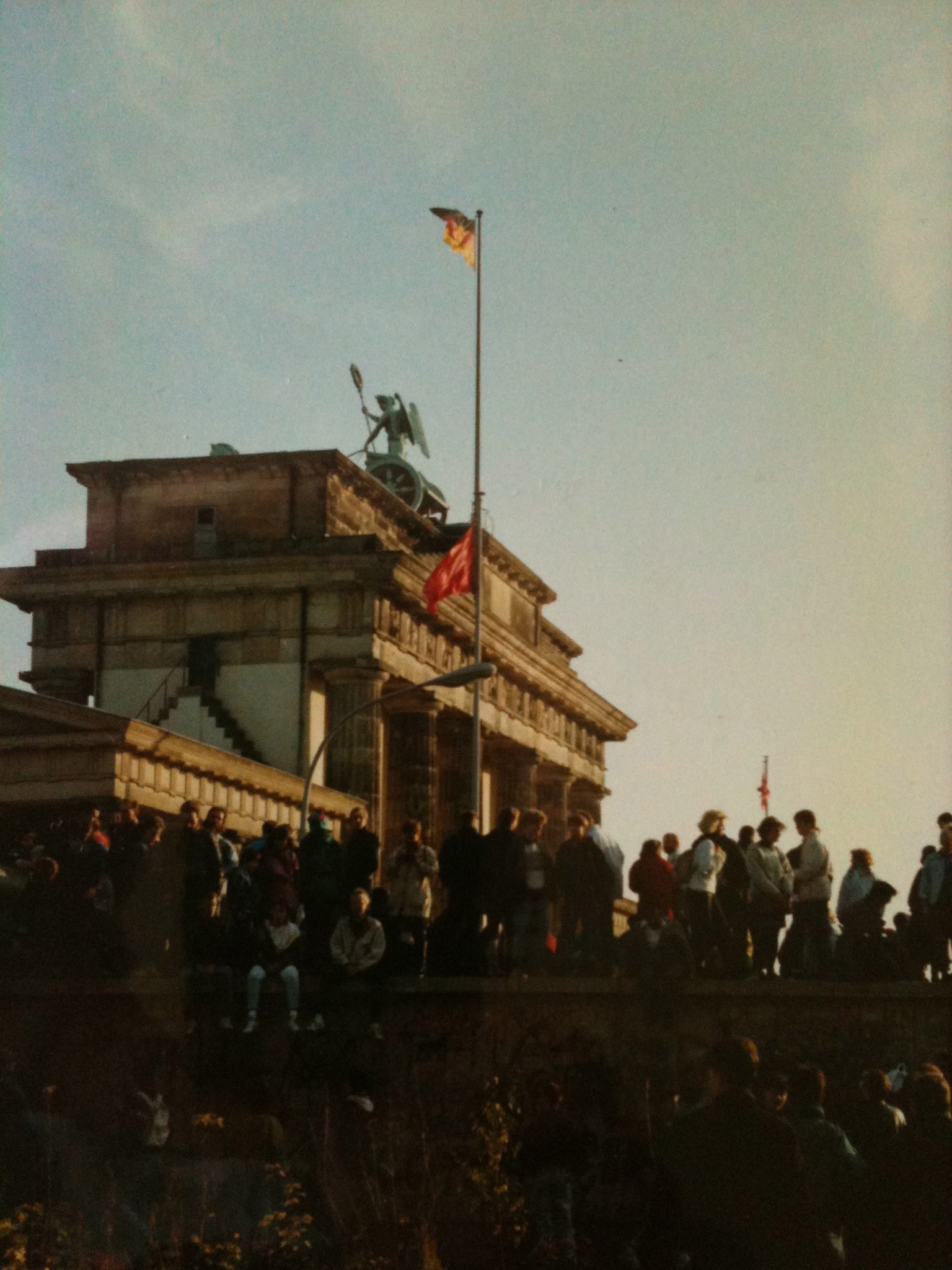
Later, we find a very useful electronic news screen on the Kurfürstendamm which fills in some of the gaps. This screen becomes our reference point for the next few days. The bank lines were East Berliners queuing for ‘welcome money’. (Years later, it occurs to me that the smiling West Berliner’s we’d passed mistook us for ‘Ossies’.) We watch Trabants and Wartburgs crawl slowly through Checkpoint Charlie to heroes’ welcomes. We hear Chancellor Kohl speak outside Schöneberg Town Hall. We stop to eat at the bar of the Film Bühne am Steinplatz. The place is heaving. Typed on the top the menu, it reads “10. November 1989, Tag des Deutschen Einheit”. Our waitress is tripping on adrenalin. She tells us she is going to party very hard when she finishes her shift.
And she will be spoiled for choice. The Ku’damm that night is one very long street party. Dance music in some venues, beer songs in others. A pair of old Berliners – gap-toothed and soaked in schnapps – dance and sing to a hurdy-gurdy.
Saturday – 11 November, Armistice Day, St Martin’s Day – is calmer. We try to cross into East Berlin at Friedrichstraße. There’s a semblance of order at the S-Bahn station – and we are suitably intimidated by Vopos patrolling the gantry with machine-guns – but at ground level, it’s chaos. There are crushes of people from East to West and West to East. Without orders on how to respond to the situation, the guards are simply brushed aside. But while entering East Berlin unprocessed and without Ostmarks might be one thing, getting back to the West later that day might be quite another. We turn back.
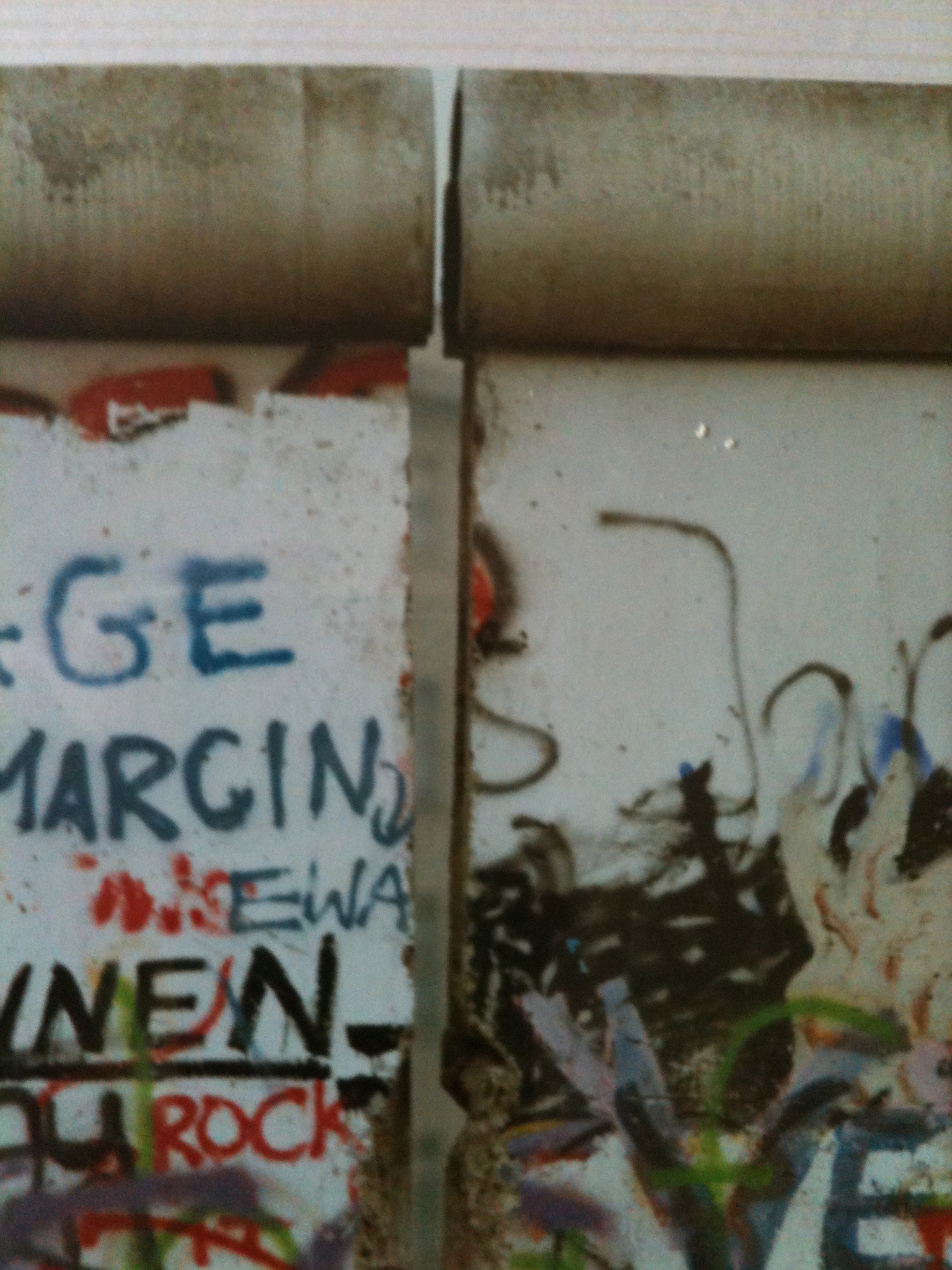
We decide to have another go at visiting East Berlin. This time, we try Checkpoint Charlie and here, it seems, normal service has been resumed. We queue for a while. In the line, next to a man from Sri Lanka who while making conversation berates us for Britain’s colonial past. A officer of the Grenzpolizei looks at our passports, looks at us over his glasses with practised skill and makes me feel I am guilty of any number of crimes I haven’t committed. We are directed first to a kiosk – to change a prescribed amount of money into Ostmarks – and then into a deserted street. It seems like a time-portal is taking us back to 1945, but we are now in the East.

We decide to go to Karlshorst, home to the Soviet ‘Berlin Brigade’ and loosely described as the “Russian quarter”. We’re not sure what we expect to find, but think it might be an interesting place to wander.
And it is while we are wandering that we see fighting – close-quarters, house to house – from the safety of the top of a street. Someone makes a crouching dash across the road protected by covering fire from a comrade in a doorway. But this isn’t Stalingrad. The soldiers are small boys, the machine-guns are plastic, and the buildings of Karlshorst are undamaged by bullet or shellfire. It’s a misty Sunday afternoon in November: play time.

No longer in silhouette, a portly man in a sober suit welcomes us. He explains that the procession is for the Feast of St. Martin. They have already walked and sung their way to the Lutheran church for a short gathering and have now – with a few Lutherans in tow – returned here, to the Roman Catholic church.
St Martin of Tours: friend to the child, friend to the poor man. The most common story about him involves his encounter with a beggar by the roadside. He takes his fine cloak, slices it in two with his sword and hands one half to the beggar. At the front, the priest takes the tale as his starting point. L has good German and whispers translations in my ear.
“Many of you will have visited West Berlin in the last few days,” he says. “You will have been excited by the lights, all the goods in the shops, received your welcome-money. Some might see our friends in West Berlin in the role of St. Martin, with ourselves in the role of the beggar. But do we see ourselves this way?”
It’s little more than a murmur, but the answer is unanimous – an indignant, defiant “No.”
“Of course not,” the priest continues. “There are many, so many, people less fortunate than ourselves. Can anyone think of somewhere where people are less fortunate than us?”
A pause. A small boy shouts out “Romanien!” A couple of people snort. Most of the adults smile indulgently.
On leaving, the portly man hands out pastries. Feeling we are not part of this, we hold back, but he insists we take one. The atmosphere is gentle, friendly, communal.
It’s properly dark and much colder when we step back outside, and the mist which has never entirely lifted is getting thicker. As we head back towards the S-Bahn we pass a Soviet officer – I don’t know what rank – standing on his own at the bus stop. He looks lost in his own thoughts. I wonder, this weekend of all weekends, what he’s thinking.
*
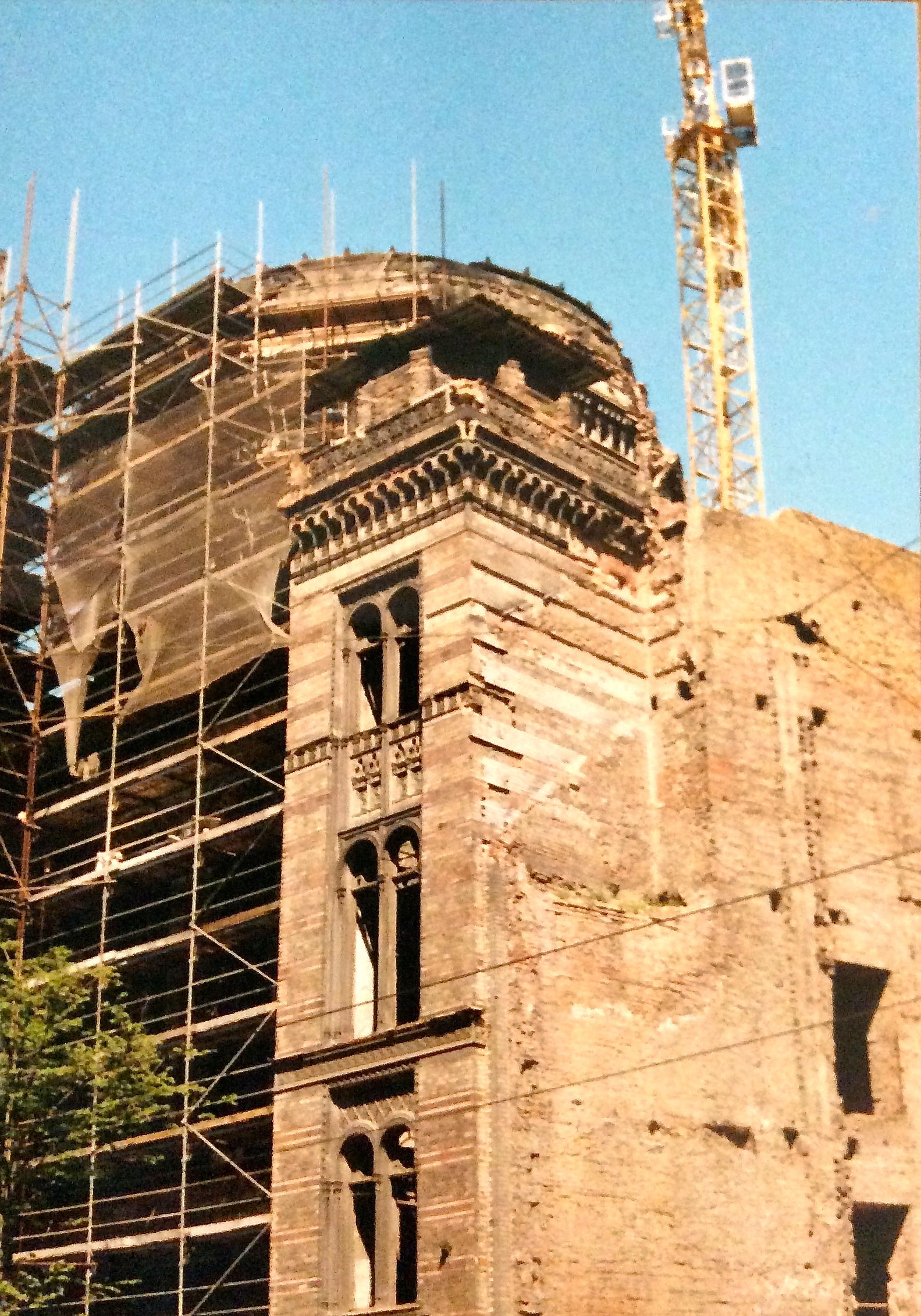
We returned to Berlin six months later, in May 1990. In some ways this was even weirder. The Wall was literally disintegrating – though still neatly whitewashed on the Eastern side – and bits of it were already being sold as souvenirs on the pavements. Restoration work had begun on the Synagogue in Oranienburger Straße. Rabbits bred and ran rampant over what used to be No Man’s Land. Some people changed money – Ostmarks for Westmarks, Westmarks for Dollars – through holes in the Wall. And yet the formalities of the border between the West and the GDR were still observed. We still had to go through Checkpoint Charlie and buy Ostmarks to go to East Berlin and the Grenzpolizei were just as unfriendly. Officially, the GDR was still a sovereign state without formal plans to dissolve, but it was clear that it was only a matter of time.

*
I have been back to Berlin many times since. We have friends there and it feels very much like my ‘second city’. Thirty years on, the future of Europe is once more uncertain, and there are leaders out there who preach unity while pursuing division. So it’s good to remember a moment, however brief, however imperfect, that really did bring people together.
[P.S. You will have gathered this is essentially a re-assembly of two much older posts. Thank you for your patience. And Happy Anniversary, Berlin.]
 geezerinhat
I need to come visit this blog more often! Your content is amazing 🙂
Thank you 🙂