‘One, Two, Three, Four, Five, Six!’: Seven Types Of Roadrunner

One Friday, in October 2006, I was skimming the music pages of The Guardian. I was already ‘old’ by then and had never been cool, so it felt like a form of tourism. But then I came across a column entitled ‘Hail, Hail, Rock and Roll!”. It was a piece about a song, well-written. Better still, the song in question was old, wonderful and ever-so-slightly odd. It celebrated youth and freedom on a solo night drive in “Massachusetts when it’s late at night,” on a long and, on the face of it, unglamorous ring road: Route 128. The song was ‘Roadrunner’ by Jonathan Richman and the Modern Lovers, and the columnist was Laura Barton.

The next year, Laura followed this up with a personal account of her pilgrimage to Route 128. And now, appropriately, we have the radio version, Roadrunner, going out on Radio 4 this Sunday at 7.45 p.m.

Better you should read Laura’s articles than have me paraphrase them here  (click on the links above). Equally, I don’t want to give away too much about the radio story because I hope you’ll listen. All I’ll say is that it gives voice to the Road, Route 128, itself: “I was built to inspire a song. A love song for a road, for a car, for music and the modern world. A song about about going faster miles an hour. With the radio on.”

Seven Types Of Roadrunner

IMG_1440However, there is nothing to stop you listening to the song immediately. There are a number of versions of ‘Roadrunner’, many of them by Jonathan Richman himself. Here are just seven.

The first, by the original Modern Lovers lineup, was recorded in 1972 and produced by John Cale of the Velvet Underground, but wasn’t released until four years later. It’s not my favourite, but it rocks hard and there’s a keyboard solo by (I’m guessing) Jerry Harrison, later of Talking Heads. This is probably the most accessible version for someone new to the song.

IMG_1441The stripped down ‘Roadrunner (Once)’ by Jonathan Richman and the Modern Lovers was a UK hit in the summer of 1977.  I prefer it, partly because it allows more of Richman’s quirkiness to come through but mostly because it allows me some nostalgia. Fourteen and introverted, I would sit at the top of the house of an evening “with the radio on, for company.” Radio Luxembourg (208) on a small tranny, to be precise. Now and then, Donna Summer feeling love, or Fleetwood Mac dreaming or The Brotherhood of Man (ahem) doing whatever with Angelo would be interrupted by something more interesting. The Stranglers. The Sex Pistols. And also this guy playing a song – mostly on two chords – about going faster miles an hour. He sang quietly about how exciting it was at night with the pine trees in the dark and how cold it was. The woo and whee of imperfect MW reception filled the gaps in the sound and seemed to punctuate the phrases with question marks.

‘Roadrunner’ is very easy to play and very difficult to capture. To my mind, no cover has managed it. The Sex Pistols’ version is a non-starter, mostly because Sid Vicious doesn’t know the words, but it does convey the simple hypnotic pleasure of bashing out the same chords over and over again. Joan Jett’s is too processed for my taste and sounds like PA music at a gig before the support band come on. Greg Kihn finds some of the “spirit of old 1956” but little of the song’s strangeness. From that point of view, Yo La Tengo’s version may be closest in spirit to the original.

You’re better off staying with Jonathan Richman. Laura writes at length about ‘Roadrunner (Thrice)’. And it’s a joy. Because of its length (over eight minutes) the drive turns into an epic journey. There is a sense of space, of time passing, and the extended soliloquy on being alone makes you wonder if there’s just a hint of whistling in the dark beneath the apparent joie de vivre. History doesn’t relate whether William Empson had views on ‘Roadrunner’ – and I apologise for using the ‘Seven Types’ so frivolously – but I think he might have found some ambiguities here.

“We’re gonna drive them home, you guys.”

IMG_1442And so back to the Road. It’s a lot to expect of an actor to characterise 58 miles of tarmac, but John Schwab‘s reading is assured and lived-in, and captures both the spirit and the rhythms of Laura’s writing. If Route 128 could really speak, it would sound like John.

I hope you enjoy it.

“Bye bye.”

LATIDO: a radio heartbeat

“Often, Steven sat in the middle of the children, looking out on the blue of the rippling, writhing ocean and the peninsula of palm trees that stretched into it a few miles down. He felt the beat of his own heart in his chest and it seemed to play into the rhythm of the water in front of him. That heartbeat, and the faint electrical current that fuzzed steadily beneath his eyes, making him slightly queasy; that was the soundtrack of Mexico for him.”

This passage is taken from ‘Latido One’, the first in a set of three stories by writer and artist Louise Stern, written specially for Radio 4. For me, it encapsulates what the series is about. Latido (Spanish for heartbeat) goes out on consecutive Fridays at 3.45 pm – and available on iPlayer thereafter – starting on Friday, 12 July.*

I first worked with Louise last year when she contributed ‘The Electric Box’ – a brooding piece in which tensions surface at a Fourth of July family barbecue – for our series Where Were You … She’d been on the air before, a few stories from her first collection Chattering went out in 2010, but this was her first bespoke work for radio. It was only afterwards that we felt this wasn’t entirely mainstream. Why? Louise is a fine writer, period: but she happens to be deaf from birth.

We wanted to do more, and met up several times last summer and autumn. At this stage, we hadn’t so much established a concept or a writer’s brief as come up with areas of exploration. Namely, the internalised ‘soundtrack’ of the profoundly deaf, and Louise’s personal passion for Mexico.

Your beating heart

DSCF0847
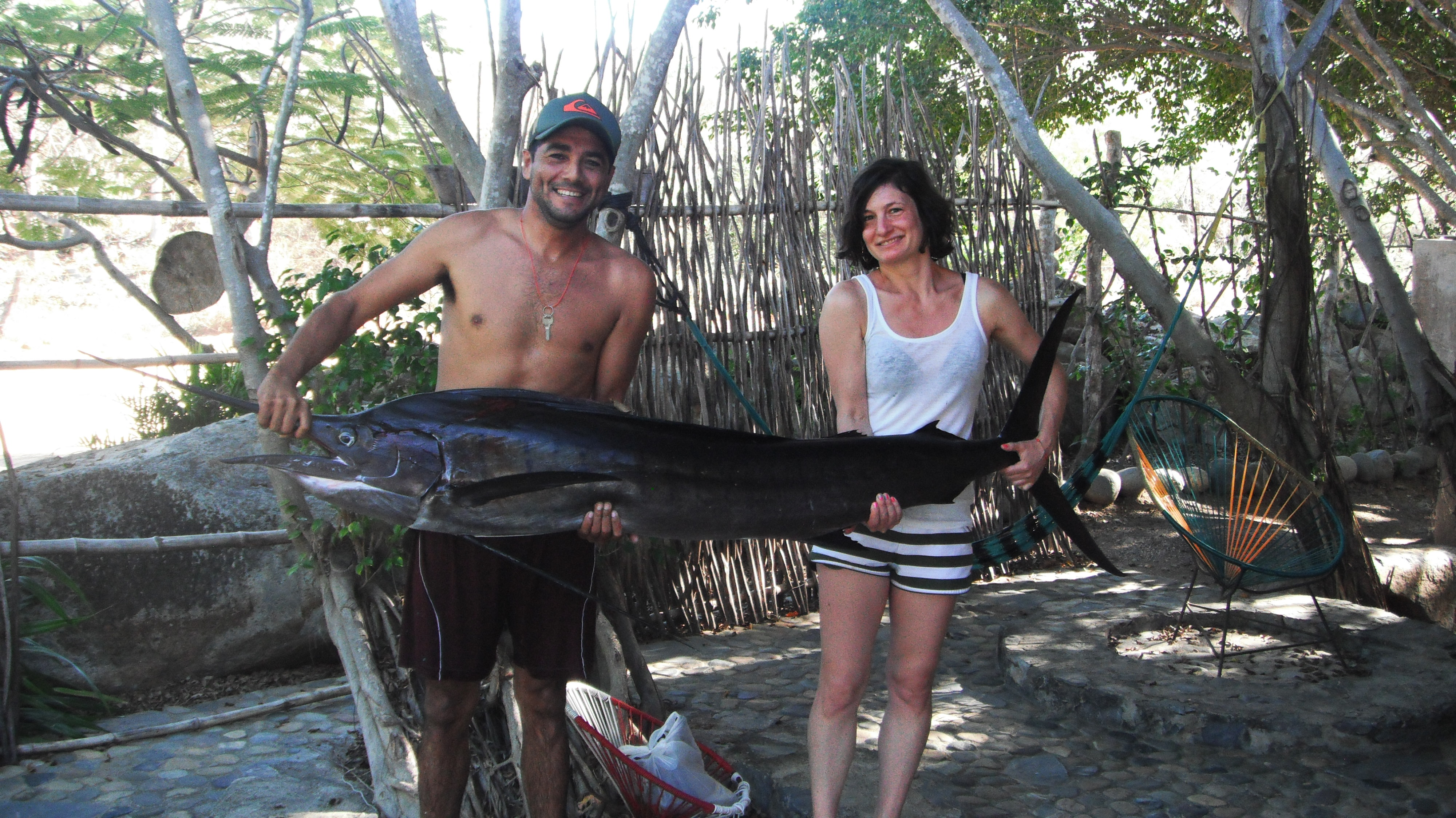
Louise and Omar with a paz vela or sailfish. A good visual aid to Latido II. © Lisa Marie Young.

This was the easy bit, of course. Louise then wintered in Mexico and got on with the hard bit of conceiving and writing the thing. The result is Latido. All three stories are set in a Mexican village and each one features a deaf central character. The heartbeat leitmotif reprises in all three tales. And none of it gets in the way of some very good storytelling. In ‘Latido One’, a deaf foreigner gets on the wrong side of the one man in the village who will not accept him. ‘Two’ takes us onto the ocean with a deaf member of a fishing crew. ‘Three’ starts out as a ‘quiet’ observational, atmospheric piece, only to turn into a story of sexual betrayal and revenge.

As a writer, Louise has a natural sensuality, an ability to zoom in on her subjects like a child in the garden with a magnifying glass and, above all, a sense of ‘otherness’ that we were keen to replicate in the recording studio. Louise Brealey (known to some of you as ‘Molly’ in Sherlock) reads all three stories and gives us this, I think. Sadly, Louise (Stern) won’t hear the stories, but she did come to the recording with her long-time interpreter Oliver Pouliot and gave us many useful steers during the day.

Sound and silence go hand in hand, of course, and we had one or two ideas for post-production. There are moments of soundscape throughout the series – in ‘One’ Louise has effectively written one in the opening pages – and the noises come from a variety of sources. There’s music by Chavela Vargas and J.J. Cale; effects from sound-man Jon Calver’s library and some wild-track recorded in ‘Louise’s village’ in Mexico by Sophie Pierozzi. And then there’s ‘the heartbeat’ – occurring at varying speeds under moments of particular excitement or stress in the characters – that Jon has ‘felt’ like a jazz virtuoso.

Cum On Feel The Noize

IMG_1389Ultimately, all radio programmes have to work on a variety of devices, and I hope you enjoy Latido whether you listen on DAB, mobile, TV, vintage portable Roberts on long wave or a 1940s wireless where the Home Service is west of Hilversum on the dial. But, if you happen to be able to listen through big speakers, crank it up loud and put your hand against one. Mostly, you’ll feel the lovely vibrations of Louise Brealey’s voice, but keep it there for long enough and, at certain times, you’ll feel the latido, the heartbeat, too.

* A transcript of each programme will be published on the Radio 4 website directly after broadcast.

For The Time Being …

The sixth season of The Time Beingthe showcase for ‘new voices’, started on Radio 4 last Sunday evening (19 May). The three stories go out on consecutive Sundays and are available on iPlayer for a week thereafter.

It’s the end of a process that began with 220-plus stories that needed to be read. And to reduce them to three posed a number of challenges. We used very good sources to amplify the call for submissions so the general standard was quite high. This was a good thing, but it meant no shortcuts were available. True, a a few stories were clearly unusable – if only because the sender had ignored our guidelines and criteria – but leaving those aside, none were poor enough to discard after the first paragraph. Every tale deserved a fair hearing.

Then there is the need to maintain the reader’s morale. One of the most interesting things about finding material for each series is to see what themes are preoccupying writers at a given time. Trouble is, if those preoccupations are dark, and you’ve read six or seven tales of similar bleakness in a row, however well told, it can get you down a little. If you sent a story for the series and you’re reading this, let me stress that I’m not having a go at you, as you didn’t write with this particular scenario in mind. It’s just an occupational hazard of the job – my problem, not yours.

Voice is all

Because we issue a set of guidelines and criteria for the submissions, it makes The Time Being sound like a ‘competition’ or prize like the V.S. Pritchett, or Bridport, or Mrs. Joyful (For Rafia Work – of blessed memory.) It isn’t. Ultimately we choose stories that we particularly like and think will work well on air. It so happens that all three stories we’ve recorded this time are first person narratives, but that’s accident, not design. Dramatic monologues can work (but be careful, they are tricky to pull off successfully), so can ‘conventional’ third person omniscience. In the end, what we look for most is voice: the sense that this story, whatever its rough edges, could only be written by this particular writer, and no one else.

Greyhound Blur © Lisa Osborne

Having said that, there aren’t many rough edges on what I think is a very accomplished set. No spoilers – because I’d rather you listen – but Marathon, by Claire Powell, tells the story of an alcohol-driven extra-marital affair (from the mistress’s point of view) that goes very, very sour when her lover decides to get fit. Llama Sutra, by Melanie Whipman, is even stranger than the title suggests, and even this preview clip – Love In The Time Of Llamas – doesn’t give away quite how strange it is. Rebecca F. John’s The Dog Track tells the story of an unusual and lonely young woman who finds herself alone at the greyhound races, weighing up a matter of life and death. As chance would have it, I was at the dogs at Wimbledon Stadium the day after we recorded the story. We went as a family and enjoyed it hugely, and there were a lot of groups and ‘birthday party’ gatherings there having fun, too. But it did strike me as a very lonely place to be by yourself.

New voices for new voices

I like ‘studio day’: so often it seems more like play than work. It helps that I’m part of a very good and lovely team. And, because each reader brings something with them you might not expect, it’s a collaborative effort. You never end up with a mere ‘aural reproduction’ of the words on the page. And to add to the three writers making their radio debuts, two of the readers were letting their voices loose for the first time on Radio 4. Camilla Marie Beeput, who brings such surprise and warmth to Llama Sutra, is a relative newcomer, for the moment – though not for very much longer – best known for doing the crossword with Yoda in the Vodaphone ad. (Sorry, Camilla!) More surprisingly – for such a good and established screen actress – Marathon is Lorraine Pilkington’s first Radio 4 appearance. If you listen to the story, and hear her beautifully calibrated rendering of the ‘other woman’, who goes from sexy to sad to ever-so-slightly sinister in the space of thirteen minutes, you can only ask: why haven’t you done this before?  Similarly, if you listen to Rakie Ayola inhabit a very complex character so completely in The Dog Track, I defy you not to want to hear her more often.

Geezer voices, ever singing …

Speaking of voices, I’m aware that my most recent posts have been driven by ‘events’, and that my own voice, or my blog voice anyway – never strong – has lately been little more than a bat squeak. For the few select fans of more random and pointless geezerposts – I hope to remedy this as soon as headspace permits.

That’s all, for the time being …

The Middlesteins: FOOD Is The Food Of Love

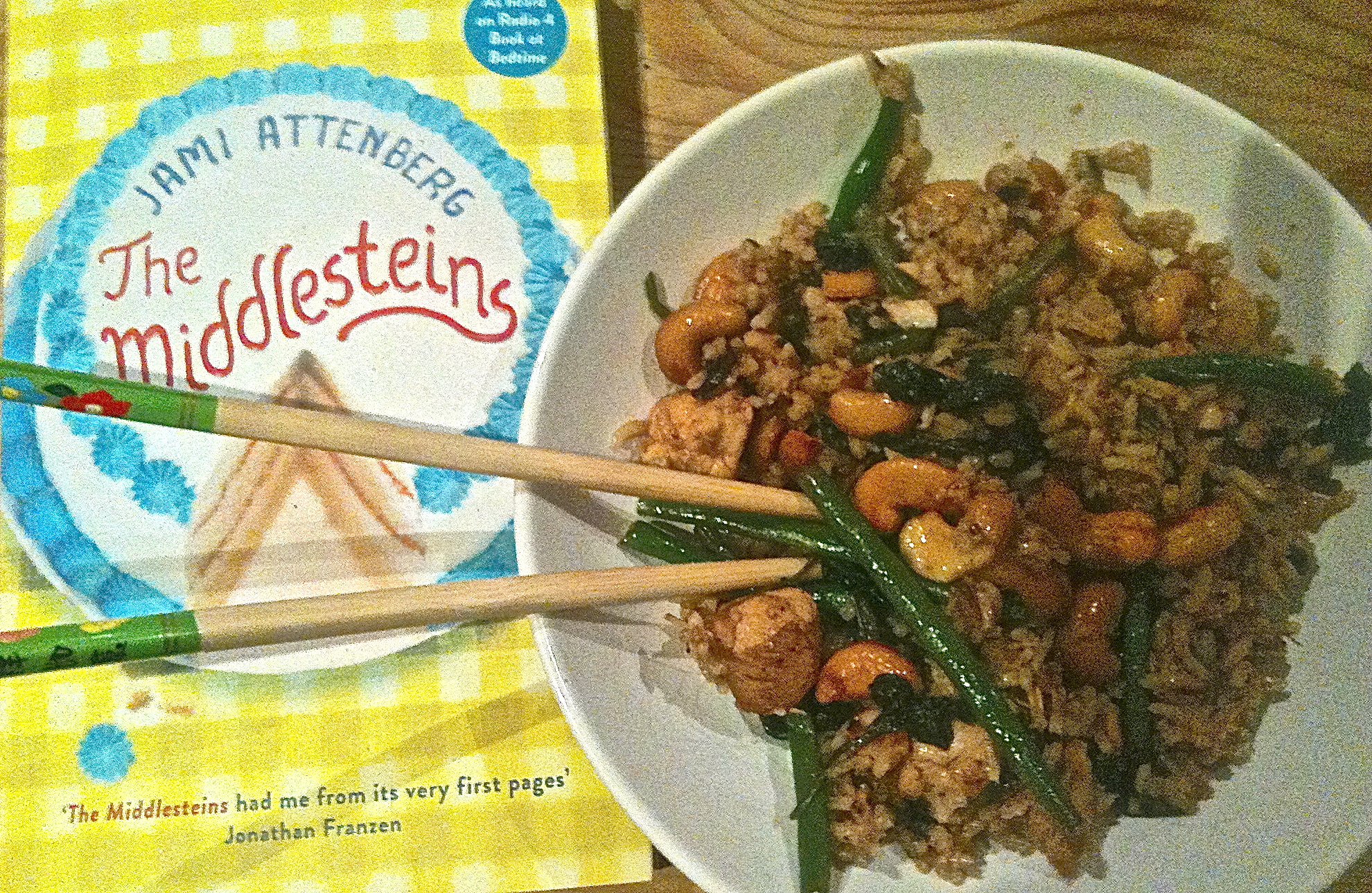
Disclaimer: the food in ‘The Middlesteins’ is often better than this.

And much else besides.

So, we have two siblings, Benny and Robin, who grew up in the Chicago suburbs. Benny is married to Rachelle, who is the sort of daughter-in-law many Jewish families would love to have. They have twins, Josh and Emily, preparing for their b’nai mitzvah. Benny tries to be a good husband and father, a still point in a turning world – though he needs a joint after work to help him. His sister Robin has a galactico-sized talent for anger and unhappiness and she likes a glass of wine, or several. In the past, Benny has worried about Robin. But not any more. He has bigger worries now: his father Richard, and in particular, his mother, Edie.

Edie was a lawyer for thirty-five years. Now, she’s a big woman with a big personality and not enough to do. And the trouble is, she’s getting bigger. She weighs in at near on 350 pounds. She’s about to have a stent put in one leg to match the stent put in the other leg six months ago. She has diabetes. There are dark murmurings at the hospital about bypass surgery.

Edie, it seems, is eating herself to death. And after nearly forty years of marriage, Richard has walked out on her.

Who are these guys? They are The Middlesteins, now published in the UK and coming to BBC Radio 4 next week (click here for the programme link). I won’t say much more so as to keep the surprise – this astute review from The Independent gives more background, if you want it – but it’s not giving away too much to say that this wonderful novel is built around food. Food is everywhere, from Edie’s reckless and continual pit-stops in burger bars to the Chinese restaurant where she finds friendship, love and a limitless menu. The fate of the family is discussed over meals at home or in restaurants. Robin attends a seder at her boyfriend’s parents house and leaves with an (unwanted) tupperware container of leftover brisket. The b’nai mitzvah features that ultimate status symbol, a chocolate fountain. As Edie’s parents conclude in the opening chapter: “Food was made of love, and love was made of food.” Edie’s tragedy is that she takes refuge in this thought and runs with it way, way too far.

Jami Attenberg, by Michael Sharkey

This is Jami Attenberg‘s fourth book and her first to be published in the UK, following two previous novels – The Kept Man and The Melting Season – and a collection of stories, Instant Love. Until now, she was little-known over here, but I suspect this has changed forever.

In a previous post (Reader’s Block), I said I was lucky enough so far to have only worked on books that I loved. This applies with additional sweet’n’sour to The Middlesteins. It’s a sad and bitter book in some ways, but underscored with heart, and it’s very, very funny. While some might describe them as dysfunctional, for me the Middlesteins are just flawed, messy and sometimes confused like the rest of us. And even though my job is finished, I find myself still worrying about them.

For the adaptation we had to lose, unfortunately, most of the chapters that deal with Edie’s back story. And one of the challenges in paring down the text was the number of long sentences with parenthetical ‘asides’. These can be an abridger’s friend – often they can be cut without losing too much that’s important in an episode. But not in this case. We’d have lost too much of the book’s flavour, those moments of ‘more-thoughts-than-I can-get-out-of-my-head-at-once’ that spit and crackle like a steak dropped into hot oil. But having decided to keep them, this posed a fresh challenge in the studio. If you read them too slowly the listener will lose track of the thread. They have to taken quickly, so that it sounds as if they burst out of your head that very moment. But reader Tracy-Ann Oberman and producer Karen Rose were more than up for it. And not only do they keep the narrative pulsing, Tracy-Ann’s characterisations (and there are a lot of them) are a delight.

IMG_0956I hope you enjoy our ‘low-calorie’ radio version (told in 20,000 of the book’s 67,000 words) but equally I hope you will go on to read The Middlesteins in it’s full, unexpurgated, sodium-and-sauce-drenched glory.

Until next time, eat and feed each other with love, but please do so (more or less) responsibly …

Annika Stranded

She doesn’t – as far as we know – have a sartorial trademark like leather trousers or a Faroe jumper. But she’s a fisherman’s daughter, with a passion for driving motor boats at high speed, so maybe state-of-the-art Scandinavian waterproofs figure somewhere. And in moments of high stress, when Sarah Lund might jump into her car without explanation, when Saga Norén might make a factually correct and emotionally clueless remark, Annika Strandhed of the Oslo murder squad is more likely to crack a joke. Trouble is, her colleagues seldom think she’s funny …

But instead of me telling the whole thing, badly, far better to listen to Annika Stranded (click here for BBC link) on Radio 4, 7.45 pm for the next three Sundays.

© Nick Walker
© Nick Walker

For some in the UK the Scandinavian crime ‘bubble’ has already burst – ‘it isn’t great and actually it’s just boring’ – but this isn’t a view I share. For one thing, I don’t think it’s a bubble. Granted, fewer lucky journalists are likely to be dispatched to Copenhagen to have coffee with the likes of Sofie Gråbøl in future, but that’s because Scandinavian crime drama has settled down to take its murky place in our everyday viewing culture, just as American crime has for decades. And for another thing, I’m a fan, a junkie even. No, I haven’t read much (although I did enjoy Henning Mankell’s The Dogs Of Riga years ago) but telly’s another matter. Dysfunctional detectives? Beautiful but bleak coastal landscapes? Murky warehouses? Wood-panelled interiors? Subtitles? Bring them on …

So when Annika-writer Nick Walker suggested his singular take on the genre, he was pushing at an open door.

The Two Walkers

They’re not related, they’re not one and the same person, but I suspect they are symbiotic in some way. The first thing to know about Nick Walker is that more people should know about Nick Walker. He has written two novels – Blackbox and Helloland – but most of his energy is directed towards radio and theatre work. Because of this, I can’t point you towards his back-catalogue in the same way as with a novelist, and can only hope you’ve caught up with some of his wonderful works on BBC Radio in recent years. To name but a few: the recent play Stormchasers  (broadcast over Christmas), the poignant and inventive Messages To A Submariner, and the First King Of Mars stories (voiced first by Peter Capaldi and later, by Dave Lamb.)

Fans of Spooks, and lately, Last Tango In Halifax, will need no introduction to Nicola Walker. TV casting has tended to put her in victim or generally-put-upon roles – and since Nicola is good in all she does it’s a safe bet – but radio has so far provided more scope to show how warm, versatile and funny she is. In Annika Stranded she is all these things, and inhabits the character so completely that it would be easy to believe she’d written the stories herself.

As luck would have it, a previous ‘Nick-ola Walker’ production, Lifecoach, is repeating on Radio 4 on 7 February. I’ll post the link when it becomes available.

Noises On

The classic approach to a radio story is ‘less-is-more’: a reader, a story and at most a little ‘top and tail’ music, putting as little as possible between story and listener. And this still works best with most stories. But Annika Stranded is effectively a series of mini-dramas – performed as such – so it needed something more. Nicola was recorded in studio – neither time nor budget permitted going to Norway – but Nick collected some very good wild-track when he went to Oslo for research. So most of what you hear in the background is authentic Oslo noise. And there’s music from Swedish duo First Aid Kit and some haunting cello from Icelandic musician Hildur Guðnadóttir, too.

This is an unashamedly biased piece. I hope that if you listen to Annika Stranded you enjoy it as much as I do. And as always, thanks for reading.

I Overheard It On The Grapevine

Well OK, Marvin Gaye wasn’t there of course, but it was good fun all the same.

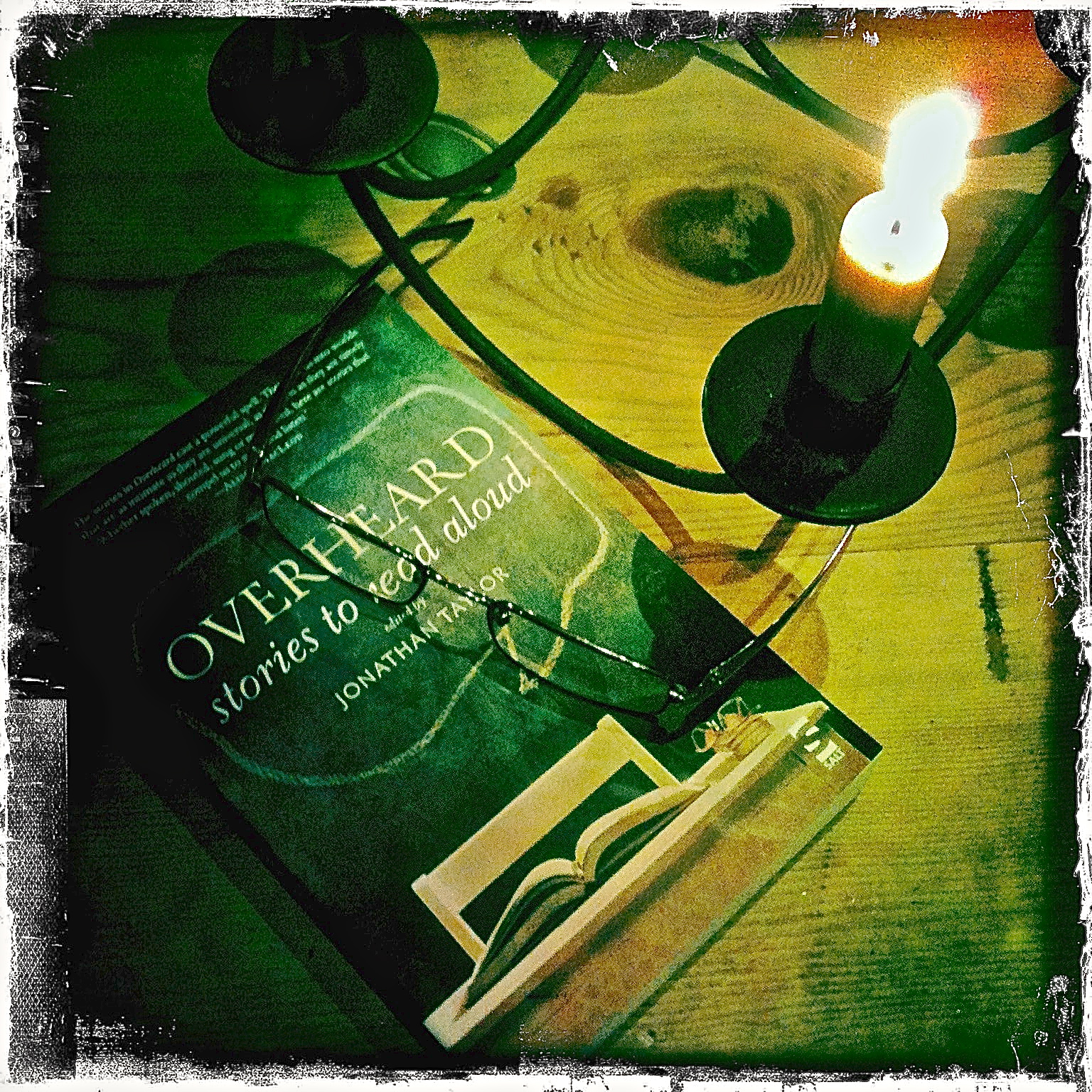
IMG_0933Last night, I went to the launch of OVERHEARD: stories to read aloud at The Betsey Trotwood in Clerkenwell. It’s an impressive collection, edited by Jonathan Taylor – also our MC for the evening – with 38 contributors (if I’ve counted right) ranging from the likes of Ian McEwan and Salman Rushdie to expert ‘flashistas’ like Tania Hershman to the oral storyteller Katherine Rogers, and with any number of good and different voices in between. OVERHEARD is available and on general sale courtesy of those resurgent, independent and wonderfully human publishers Salt.

About half the authors were there in person to read extracts from their stories (or the whole thing, if they were very short.) It would be unfair to single out anyone as such, but I would like to mention two names I’d not heard of until last night: Alexandros Plasatis – whose hilarious, 18-certificate tale Confessions of a Great Lover brought the house down – and Emma J Lannie’s quieter but no less arresting ‘short short’ One Two.

On the tube home I read Jonathan’s introduction. Better for you to buy the book and read it than for me to paraphrase here, but it raised some thoughtful and interesting points about the traditions of oral storytelling and distinctions between public ‘performance’ and stories read aloud intimately at home. This picked up on something I’d been thinking about during the evening. In the first half, I sat at the front, close to the reader and the mic, and was aware of concentrating on the performance. But in the second I was at the back – oddly it seemed more as if I was listening ‘one on one’.

Salt don't do barmaids, but if they did ... (With apologies and love to Alison MacLeod (left) and Jen Hamilton-Emery
Salt don’t do barmaids, but if they did … (With apologies and love to Alison MacLeod (left) and Jen Hamilton-Emery)

Stories on the radio – or good ones, anyway – have a bit of both experiences. Actors read them, so even with the lightest directorial touch performance is built in to some extent, but there’s the one-on-one intimacy too, since what we’re aiming for is a story for about 400,000 single listeners.

Readings aside, the craic was good, too. It’s always nice to catch up with the likes of Jen Hamilton-Emery (Salt), Tania H and Vanessa Gebbie but great also to meet some ‘onliners’ in the flesh for the first time like Alison MacLeod, Elizabeth Baines and Katy Darby. And the barman downstairs gave me a brief, knowledgeable and passionate tutorial on single malts …

Next week’s post will have a Scandinavian flavour – big time. But until then, thanks for reading.

Angels and Acrophobia (Part Two)

ACROPHOBIA

When the angels in Wings of Desire aren’t dispensing comfort, or acquiring mortal shape to take up with trapeze artists or kicking their heels off-duty in the Berlin State Library, they spend a lot of time soaring up to or swooping down from considerable heights. A favourite vantage point is on top of the Siegessäule (Victory Column). Although I have a passable ‘angel-overcoat’ there’s plenty of circumstantial evidence to suggest I’m not of their number, such as lack of pig-tail, no wings and less-than-beautiful soul. But let’s put that to one side. Conclusive proof that I’m not an angel, should it be needed, can be found in the details of a trip to the Siegessäule over Christmas in 2002.
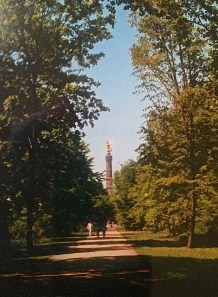
IMG_0924The Siegessäule was originally designed to commemorate the Prussian army’s victories over the Danes in 1864. By the time it was completed in 1873, Austria and France had been similarly defeated and the princes of the German states had convened in the Hall of Mirrors at Versailles to proclaim Wilhelm I as their Emperor. So the Siegessäule became a monument to the military and economic power of the new German Empire. The winged Victory herself – Goldelse as Berliners call her – still watches over the city from a height of about 67 metres. And a narrow viewing platform, a mere 51 metres high, gives good views of the city should you wish to climb the 285 spiral steps to get there.

Unfortunately, in 2002, our assembled party of two families did wish to climb the 285 spiral steps to get there. My daughter wasn’t even two back then so I carried her, as a father should, and for a while this was OK. But as we went round and round and higher and higher my fears about height took control. Worse, I started projecting them onto my little girl, who seemed way too restless and reckless in my arms. (She wasn’t – it was just me.) Eventually, her godmother took her so I could concentrate entirely on getting my jelly-legs to the top. As for the good views of Berlin, I was too busy pressing myself against the wall to notice them. I was left alone to manage a slow and grateful descent: legs trembling, mouth dry, palms sweating.

Vertigo?

It felt like vertigo. And like a lot of people I use the word freely to describe my problem with heights. It’s a proper medical condition, and it’s the title of my favourite Hitchcock film, so it has to sound better than saying: ‘heights scare the crap out of me.’ But this isn’t accurate. Dizziness and a spinning sensation are the key symptoms of vertigo, and they can be triggered by any number of situations, of which extreme height is only one. Early in Vertigo, James Stewart uses the correct term – for my problem, anyway: acrophobia. Which put simply means ‘heights scare the crap out of me.’

“I’m not afraid of heights. I’m afraid of falling.”

It’s a great line, of course, from Harry Dean Stanton in another Wenders film, Paris, Texas. But I wonder if it’s right. In my case, I think ‘drop’ is the key word. I stood in the Alps one summer and looked down on glaciers, clouds and small planes and found it exhilarating. But winding mountain paths to get there, with what to me looked like sheer drop on one side caused only anxiety. Worse, watching my kids skip quickly and fearlessly up those paths ahead of me left me panic-stricken. Cable cars are OK, provided I don’t look down when going past a pylon, which points like a giant arrow to earth and reminds me how high up I am. I’ve learned to be Zen-like about flying. But places like the Siegessäule, where you appear to be standing above well, nothing, are, I think, best avoided. And you’d never catch me up the Eiffel Tower or the Shard.

I can’t find a cause in any height-related childhood traumas. There’s a dim, small-child memory of cliff-tops, presumably from a family holiday, but it’s unthreatening. And to the best of my knowledge no-one dangled me from the top window of the house when I was a baby. So I guess it must be to do with an over-developed sense of self-preservation. Unless I’m subconsciously afraid that if I get too close to the edge gravity will whisper malevolently at my back, like an invisible Mrs Danvers of the universe, and coax me into letting myself go …

Before anyone starts calling the helplines on my behalf, I think it’s just self-preservation.

Crossing the gorge

Time was when I wouldn’t have even tried. But I did manage this in Switzerland, getting across a distinctly swingy bridge. And it was embarrassing, knowing the family were watching their useless wreck of a husband and father teetering across with rigid-neck (so as not to look down), but not without some small sense of achievement. More recently, I visited my son in Bristol and we made a return walk across the Clifton Suspension Bridge. I’d love to recount how I marvelled at the magnificent engineering and the sheer grandeur of the landscape, but of course I did neither, and kept my eyes fixed firmly on the other side.

Sadly, even though it’s well fortified with anti-climb barriers and high railings, there are large plaques with the Samaritans number at either end of the bridge. Which tells its own story, and brings me back to the angels.

It’s corny, but I find the image of crossing a gorge helpful in keeping going despite occasional depression and the paralysis that comes with it. Keep your eyes fixed on the other side, don’t stop, don’t look down and don’t look back. I’d love to think that an angel was helping us across the gorge, but I assume not, so we have to look out for each other instead.

And I hope one day to stop on the bridge above the middle of the gorge – not from fright, but simply to admire the view.

Angels And Acrophobia (Part One)

ANGELS

“Als ein Kind Kind war …”

IMG_0862Recently, I watched Wings of Desire again. Some of its images I’ve carried with me half my life, but I hadn’t seen it in decades. When I first saw it – in a West End cinema in 1987 – I wasn’t a child, but a young man who hadn’t entirely put away childish things. Back then, the first hour or so was the most wonderful thing I’d seen on screen, as the angels Cassiel (Otto Sander) and Damiel (Bruno Ganz) hovered over West Berlin, compassionate and watchful. Thereafter, I thought the wanderings of the old man, Homer, as he tried to make sense of his own and his country’s past in his quest for an ‘epic of peace’, dragged on. And – while the story demands that Damiel becomes mortal to pursue his love for Marion the trapeze artist – for me, the spell was diminished the moment he fell to earth. But what a beautiful film, all the same.

So what did I make of it this time, months away from an unwelcome and ‘significant’ birthday? When you revisit something you loved way back, there’s always the risk it will no longer enchant you as it once did, leaving only anti-climax and a sense of loss.

But it was even better this time. That first hour or so is still one of the most wonderful things I’ve seen on screen. These angels – with pig-tails and heavy overcoats, visible only to children – don’t shine with the blinding light of an implacable God. They are ‘lived-in’ and all too human as they listen to the troubled thoughts of Berliners on the U-Bahn or in the State Library and give out their unseen, unheard solace. (And who couldn’t use a ‘cosmic hug’ in their darkest moments?) The idea of Peter Falk as an angel who sold his celestial armour for 500$ in New York after falling to earth still makes me smile. The ‘Homer’ scenes are more essay than story but now I had more time for them. Homer goes to Potsdamer Platz, the hub of the Berlin in his youth but now a wasteland destroyed first by war and then the Wall, which cuts across the old tramlines. It was like this the first time I went to the city. But now it’s a hub again, bling, all chrome and plate glass and neon. If nothing else – although it’s so much more – Wings of Desire is a document of a weird city when it was at its weirdest.

Marion (the sadly late Solveig Donmartin) seems more sympathetic and much more beautiful than she did when I was twenty-four. And for anyone who can’t hear the name of Bruno Ganz without visualising Hitler foaming at the mouth in Downfall (or in any of the Hitler-memes on YouTube), this film is the perfect cure.

Wings of Desire is part of the European cinema canon. But Wim Wenders’ sequel, Faraway, So Close! (1993) passed me by – partly because I was distracted by impending and actual fatherhood – and it appears to have passed others by too, or disappointed them. So I watched it for the first time and found it better than I’d been led to believe. There’s a new angel – the sad, beautiful Raphaella (Natassia Kinski) – and a well-dodgy character called Emit Flesti (Willem Dafoe, naturally) who flits effortlessly between the worlds of angels and men before revealing himself, in the last reel, as ‘Time’. Peter Falk is here again, along with cameos by Lou Reed and, oddly, Mikhail Gorbachev.

Since Damiel fell to earth at the end of Wings of Desire, Cassiel has watched over him and seen him marry Marion, have a child and start a pizza restaurant. Angels are not allowed to interfere physically in the world of men, so when Cassiel rescues a child falling from a balcony he too becomes mortal. And for a while he is reunited with Damiel. But whereas Damiel has made a very decent fist of being a man, Cassiel is probably better suited to being an angel …

Once again, we have a permanent record of a city in flux. This time it’s the strange days after reunification, when the Wall has crumbled and the cranes have moved in to start building the Berlin of today. There’s more storyline and more humour in Faraway, So Close!, but somehow it’s messier. And however good or bad, no sequel could ever recapture the magic, the wonder, above all the surprise of that first ‘hour or so’ of Wings of Desire.

After Faraway, So Close! I moved on to City of Angels, the American remake of  Wings of Desire. But I reacted so violently against it I switched off after half an hour. Too on-the-nose for my liking, and whereas the closeness of angels to people is compassionate and beautiful in the Wenders films, here it just seemed creepy. Perhaps if I’d persevered it would have turned out good in its own terms: but it wasn’t doing it for me.

On my first trip to Berlin, in 1989, we flew in at night. As we closed in on the city’s landmarks, and the sinister (as I thought it then) Fernsehturm flickered in the dark, I had the strings and voices and synths of the soundtrack in my head. And though some strange things happened over the next few days – like the Wall falling – I was still disappointed not to see Bruno Ganz standing on the ‘broken tooth’ of the Gedächtniskirche. But waiting to go home, in the departure lounge at Tegel, I saw Otto Sander, lacking pig-tail or wings but nevertheless looking like Cassiel, waiting unobtrusively for his flight to be called. And this was childishly pleasing.

So what has any of this to do with acrophobia? As it says at the end of Wings of DesireTo be continued.

Reader’s Block

As New Year resolutions go, it seemed simple enough. And – unlike doomed plans past to be smoke free, more efficient, less vain – one I thought I could keep. All I had to do was read a few books the way I used to: chosen on whim and without a radio agenda. I wouldn’t cast readers in my head. I’d enjoy twists of plot and sub-plot without wondering which ones to cut and I wouldn’t try to break the story into episodes. And never once ask the question Will This Work?

And so, books were gifted and books were bought. And early in 2012 I put them in a neat pile by the bed. You know the punchline already: they’re still untouched, ten months on.

I’d love to put hand to brow and sigh like a consumptive poet and plead overwork – but I can’t. Yes, I do get sent a lot of books for the day job (I do read these) not to mention short stories (most of which are commissioned and loved, so no complaints there either). Equally, I’m a) lazy b) correctly distracted by family life c) incorrectly distracted by Test cricket and the Champions’ League. But I do think that when it comes to ‘extra-curricular’ reading I’ve developed a mental block.

Still, like the first guys to take pickaxes to the Berlin Wall, I’ve made a few small chips in the concrete in recent weeks. The Silent History continues to engage and I’ve started to read Pedro Páramo. Granted, someone I’m working with put me on to it, and when finished it will be a useful point of reference between us. But Pedro Páramo probably won’t be on Book At Bedtime. And sadly, Juan Rulfo died in 1986, so I can’t commission some bespoke stories from him. So as I see it, this is ‘reading without agenda.’ For those who don’t know (and I didn’t) Rulfo was a major influence on the likes of Gabriel García Márquez and, while no one has been born with a pig’s tail yet, I can see why. More on this another time.

To be clear: I like what I do. It’s a privilege to read good books by good writers, often before publication, and call it work. But sometimes it would be nice to be Joe Reader again, too, and it would help keep my judgment fresh.

The Abridger Has Been Drinking?

The next abridgment beckons. So far I’ve been fortunate to work only on novels I love and have chosen myself. Because of this, ‘going native’ in the world of the book has been all too easy.

Mostly this is harmless, perhaps no more than compiling an appropriate soundtrack to listen to while getting into the zone each day. It can be inspired by music alluded to in the book or by something that just feels right. The playlist for Olga Grushin‘s The Dream Life Of Sukhanov was a champagne and truffles affair of Russian opera and heart-rending piano music: great for the work, not always so good for my emotional well-being. Patti Smith provided the background for … Patti Smith (Just Kids), which because I played loud during screen-breaks tested the patience of my kids. No And Me (Delphine de Vigan) prompted listening to French pop, which prompted only derision from my kids.

But sometimes it goes beyond music. I was so engrossed in The Glass Room by Simon Mawer (music – solo piano by Janáček) that I cleaned (!) the big windows near my desk to enhance the sense of glass and light. But while I like our house, the Villa Tugendhat it ain’t, so no amount of imagination could turn the view of a Tooting backyard into a Moravian landscape. Even so, the characters became so vivid that their plight – rather than technical issues – began to keep me awake at night.

And then there was bullfighting. The most dangerous way to finish off a bull in the ring is the recibiendo, in which the matador stands still and encourages the bull to come and have a go if he thinks he’s hard enough, whereupon the unfortunate beast charges onto the point of the bullfighter’s sword. Quite often the bull is indeed hard enough, which is what makes this method so risky. Wena Poon evokes the choreography of the corrida beautifully in Alex y Robert, so much so that I tried to mime some of the matador’s best moves. I had just mastered what I thought was a pretty good recibiendo (complete with air-cape and air-sword) when my then12-year-old son walked in, said nothing and fixed me with a look of extreme pity.

These are a few examples. I’m not sure whether it’s good (shows empathy with the text), bad (lack of editorial detachment) or simply confirms the need for continued medication. But I get there in the end.

So this is the trade off. Less breadth, for now, but a few books each year that I experience more fully than I would if reading in a conventional way.

And thank you for reading – all thoughts on overcoming a ‘recreational reading’ block welcome. It’s time to put a playlist together for the next book. I’m not sure, but I think Tom Waits might be in there somewhere …