DISCO

An update from the day job:
People don’t always notice Marnie Crawford, and when they do, they tend to underestimate her. She has a Masters in Social Sciences, and was so unobtrusive at university that “the tutor didn’t even know {she} was enrolled until [she} turned up to a viva.” From uni she went on to the police, where criminals duly failed to notice or underestimated her which – given her superior arrest record and solve rate – was extremely unwise.

With their own arrest record in steep decline, the Ministry of Defence has created a new unit within the Military Police. As an experiment they have chosen a civilian to lead it. Enter Marnie, with her expert knowledge of bias theory, a tendency to work out her thinking via voice notes, and an impressive collection of Sister Sledge recordings on vinyl.

DISCO (Radio 4, TX 2 -6 June 2025) takes a bias for each episode (Functional Fixedness; Anchoring Bias; Belief Perseverance; Hot Hand Fallacy and Hostile Intent Bias). Marnie’s knowledge often helps her, but sometimes it creates red herrings. And DISCO itself is something of a red herring. Granted, Marnie likes to escape from her own head into four-to-the-floor music, but the unit she has been asked to head up is called Defence: Serious Case Operations.

And of course, everyone refers to it as “DISCO”.

The series asks two questions. 1. Who killed Adam McTavish, tuba player in a military band? and 2. Who is Marnie sending her voice notes to?

Bryony Hannah is the voice throughout. And the writer is Nick Walker …

* * *

The sixth and last series of Annika Stranded was recorded in the early weeks of the first lockdown in 2020, with producer, sound engineer and coordinator tuning in remotely, and Nicola Walker performing from her newly-configured cupboard/home studio. Working with colleagues and ‘talent’ in three dimensions, in a real studio, is still much better, I think – and unquestionably more fun – but the remote MO has outlasted the pandemic to become an entirely reasonable way to make programmes. It is easy to forget how new and strange it was back then.

Annika has since moored her speedboat in Glasgow, in a reimagined Annikaverse for TV (Alibi/BBC). Her family dynamic is very different but – with Walkers Nick and Nicola still at its heart – the spirit of the original radio shows is never far away.

But this is not a post about Annika. Partly this is catch-up after six years of blog-silence, but principally it’s to remind you what a fine writer Nick is.

In 2021, we collaborated with him on a series of stories called Making Amends. Essentially, this was a La Ronde of human frailty, starting with an alcoholic who tracks down someone to apologise to, only to find that the person they sought was not at home because they were, in turn, seeking to make amends to someone else. Again, we recorded all five readers – Hermione Norris, Stuart McQuarrie, Tracy Wiles, Rosie Cavallero and Tony Gardner – remotely or semi-remotely.

But also, I’d like to remind you of the prodigious talent of Bryony Hannah. We first worked together about twelve years ago. Since then, I’ve tried to work with her as often as is reasonably possible. She has an extraordinary ability to find a character, a life, a backstory in even the most pared-down script.

Last year, thinking about a new Radio 4 slot – described by Nick as “Book at Bedtime without the book” – we asked Nick and Bryony to get together from the very outset. The result is DISCO. I hope you enjoy listening to it as much as we enjoyed making it. If you want a sneak preview of what to expect, click here.

P.S. Sepsis Confidential: 2 will be available very soon.
Same geezer, different hat: After sepsis

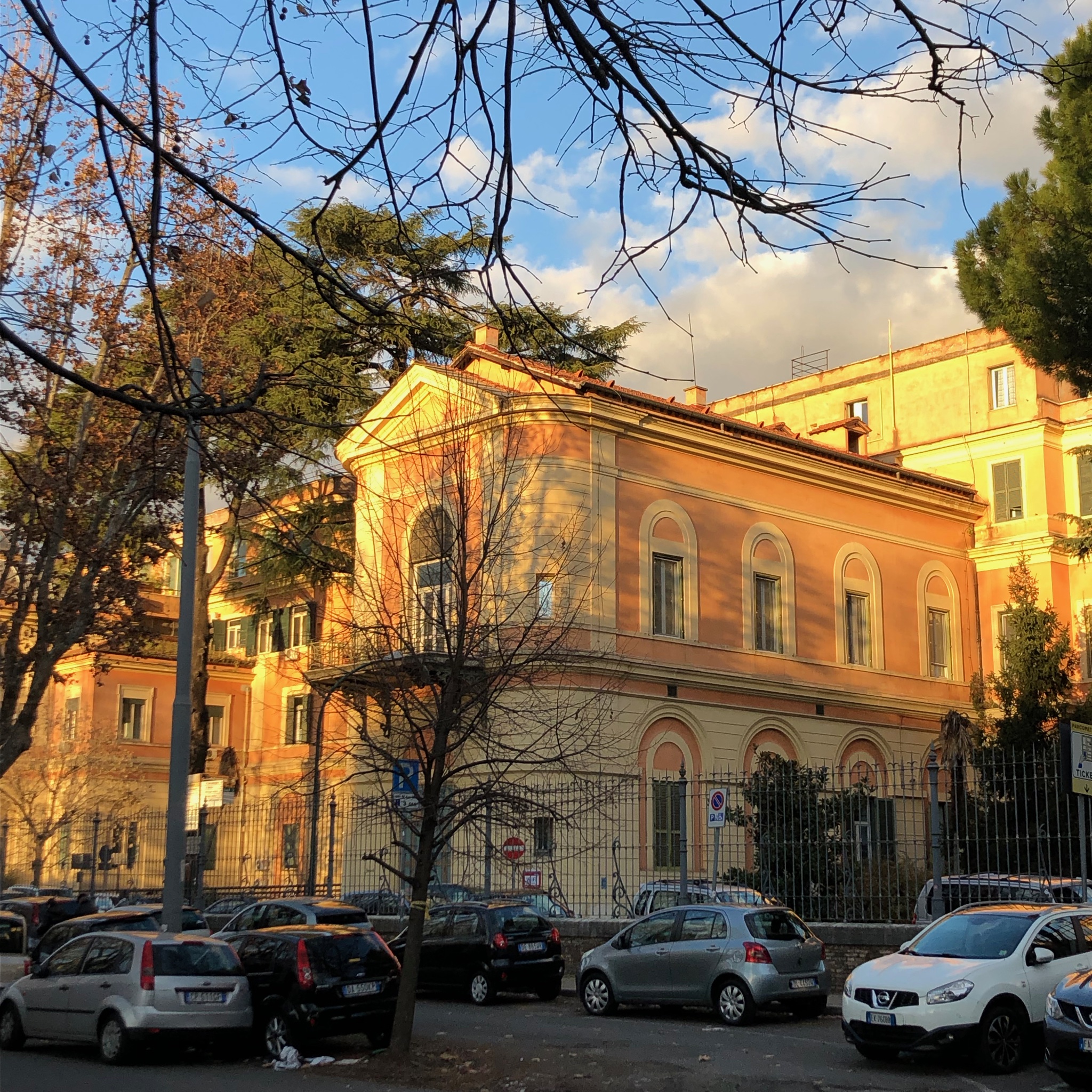
Policlinico Umberto I [photo by Lisa Osborne]
As hospitals go, Policlinico Umberto I in Rome is big. So big that you might need an ambulance – as I did – to transport you from one ward to another. So big that you might borrow from Douglas Adams’ rap on the size of space to describe it: from most parts, it really is a long way down the road to the chemist.

Malattie Infettive (Infectious Diseases) is in the south-eastern corner of the hospital. I’m lying in bed in a new side room, still unable to sit up unaided. Finding my veins has been a challenge for the nurses, but I’m cannulated and antibiotics are dripping away along with a medicinal compound, the colour of school lemon curd, in place of food. I no longer need a nasal cannula for oxygen. I don’t have a firm shake-hands grip on reality just yet, but I’m getting there.

Sundays are quiet in Malattie Infettive, with less bustle and fewer animated, Italian conversations echoing in the corridor for me to misinterpret. The Sunday before I’d only just arrived here, partly delirious, and in a room with a light-heavyweight crucifix on the wall where I hoped a clock might be. I had no watch, and the tinted acetate covering the window made it hard to interpret the Roman daylight. By the time my wife arrived at the start of visiting I was convinced, wrongly, that it was already Monday. I berated her, unfairly, for not coming to see me the ‘previous’ day.

And the Sunday before that, I was in the ICU, just about alive.

But now it’s the morning of Sunday 20 January and I may be wiggling my toes. This is something one of the doctors has encouraged me to do and I have decided to trust her absolutely. And right now, I’m not good for too much else. Any wiggling I might be doing is interrupted by the arrival of the medical director. I can’t remember whether he examines my feet with their black, necrotic heels and ‘foot fingers’. This is as much a social call as a clinical visit. In faltering but impressive English, he asks me how I’m doing.

Before he leaves, he tells me I am the luckiest sepsis patient he’s ever seen.

Some ball-park stuff about sepsis, or blood poisoning, as it is sometimes described. According to the UK Sepsis Trust, “Up to 80% of patients survive sepsis.” But should you develop septic shock, that figure changes to around 50%: the toss of a coin. And should you survive, there’s a risk of long-term complications or damage to vital organs, or you may need amputations to keep you alive. Because it often starts by looking like something else, sepsis is not always easy to spot.

In my case, towards the end of a family holiday in Rome, I noticed the beginnings of what I thought was ‘a bit of a cold’. This developed into a fever alternating with abnormal chill, became bringing up blood, became mottled skin, became being unable to move because too weak and in too much pain from a swollen left knee and right wrist. By the time I was admitted to Umberto I, sepsis and septic shock were presenting as double pneumonia and soon afterwards as cardiac arrest. After a few precarious days, a blood test revealed neisseria meningitidis bacteria as the principal cause of infection, and appropriate antibiotics turned things around. Because I was in an induced coma for six days, the critical time was much harder for my family than it was for me.

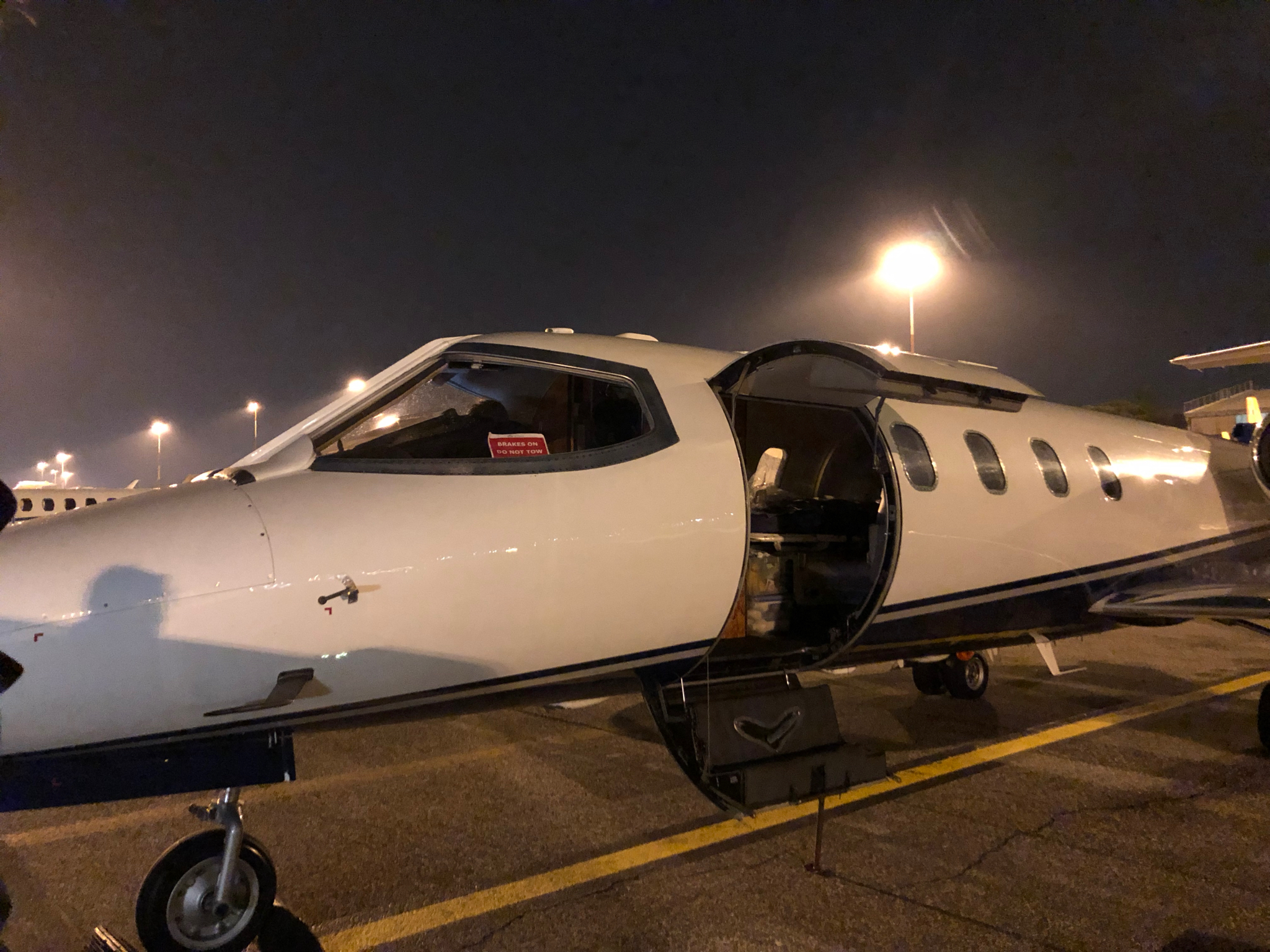
Strapped to a trolley, take off was disconcerting and apparently my monitor readings went haywire. Thereafter the air ambulance was cool. I lay back, turned my head to the window and looked at the stars. [Photo by Lisa Osborne]
I was well cared for in Umberto I for nearly a month, after which I was deemed strong enough to fly home by air ambulance. I then spent a further ten days in a London hospital before finally going home.

They say it takes at least a year to recover fully from sepsis. Six months on, I am still processing what happened. Perhaps because I was oblivious at the most dangerous time it has taken this long to accept how ill I was.

Six months on, there’s a part of me still lingering or even malingering in Umberto I. There are moments of existential fog, swings of mood, random tearfulness. All of this is consistent with what they call Post-Sepsis Syndrome. I am still disturbed, sometimes, by the vivid hallucinations I had in the ICU, and by the period of ‘parallel reality’ that followed for at least a week after I came out of the coma. (Interactions with my family were normal and accurate, but at the same time I firmly believed in a delusional, often paranoid soap-cum-psychodrama about the doctors and nurses, built upon conversations overheard in a language I do not speak!)

I will hate forever the rubbery smell of an oxygen mask.

But, at the time of writing, I am systemically well. I am working again, gently, with a new series of Annika Stranded and a set of stories from Zoe Gilbert’s Folk already under my belt. My mobility has been impaired, temporarily, by the damage to my feet. My toes will be shorter and uglier by the time the podiatrists have finished, but I will still have them, and this wasn’t a given at the beginning of the year. Psychotherapy, physiotherapy and a supportive GP are all playing their part in recovery.

What recovery will look like, I don’t yet know. I suspect it will be that point at which I am no longer thinking about recovery.

But the man at Umberto I was right: I am very lucky.

Why am I telling you this? Partly, I suppose, to increase awareness about a disease that kills a lot of people and damages many more. My life – and my family’s life – changed the moment I lost interest in Michelangelo’s ceiling and began to feel ill and stressed and anxious in the Sistine Chapel at the start of 2019. I don’t plan to turn this site into a ‘recovery journal’ but, just as my body is changing, so is my outlook. Now that my sepsis experience is out there, it should be easier to return – as I hope to do more often – to other topics.

And now seemed like a good moment to freshen up the look of my page. Same geezer, different hat. I hope it works.


Annika Speaks! (Reprise)

Do not mess with this detective [photo by Jeremy Osborne]
‘Vertigo’, the last story from the third season of Annika Stranded, goes out tomorrow at 7.45pm on BBC Radio 4. Thereafter you can catch the whole series on BBCiPlayer. In case you missed it when it first appeared on the Sweet Talk Productions Facebook page, below is a short interview with the voice of Annika, Nicola Walker.

How did you react when you read the scripts for the first series of Annika Stranded?

I fell in love with Annika immediately. She just jumped at me off the page! Straight away it was obvious that Nick [Walker] had created this woman who was fabulously complicated, funny and totally unique. And she’s ‘difficult’ in the most appealing way, I love difficult women.

In the bubble of the studio, the boundaries between where Nicola ends and Annika begins seem ever more blurred. In what ways do you identify with Annika Strandhed?

Annika is definitely my fantasy alter-ego! Her work and her private life are mashed up together and she’s never anything less than true to herself. She’s far bolder than me, far less concerned about other people’s opinions, I love that about her. And I love her attitude to the darker, difficult parts of her job and her life. I found similar traits in Stellan Skarsgard actually, he would greet a tricky filming day with a shoulder shrug, a smile and a murmur of “it is what it is, Nicola, it is what it is”.

Annika Stranded evolved out of Nick Walker’s love of ‘Scandi-crime’. In recent times as well as Annika you’ve been DCI Stuart in Unforgotten and Stevie in River. Do you enjoy crime fiction/crime drama as a ‘private citizen’, and if so, what?

When I watch tv crime drama now I’m always trying to suss the end, from the opening credits on, I’m shouting at the telly to the great annoyance of my family. I watched a lot of police documentaries for ‘Unforgotten’, like ’24 hours in police custody’, I’m now addicted to them. But I’ve always admired Gordon Burn’s work, both factual and fictional. And you have to go a long way to beat Joan Smith’s collection ‘Misogynies’, which contains one of the most brilliant and shocking essays on murder crime I’ve ever read.

What are the pleasures of working in radio compared to TV?

Radio is my favourite medium! You can be anyone, do anything and go anywhere. You are not confined by visuals – the possibilities are endless. I sit in the studio on one side of the glass running between three or four different mike stations often and the world is conjured up by three brilliant people on the other side of the glass. There are no physical limitations, we can cross oceans, climb mountains, visit the Reindeer Patrol and then be inside Annika’s head in an instant.

What are you working on now or will be working on soon?

I’m doing more audio drama at the moment, playing Liv Chenka in a new Big Finish Dr. Who story. There’s a Tango Christmas special coming on soon which, as you would expect from Sally Wainwright, is fabulously dark and funny. Then Unforgotten 2 goes out early next year, with Cassie and Sunny handling a completely new case.
After that I am crossing my fingers and toes that we find a way to do more Annika. I miss her already.


Reindeer Police Are My Weakness: Annika Stranded – Series 3

Annika [photo by Jeremy Osborne]
Earlier this year, the last episodes of Swedish TV’s loose adaptation of Maj Sjöwall and Per Wahlöö‘s Beck introduced Steinar, a Norwegian detective, to Stockholm’s homicide division. Steinar (played by Kristofer Hivju) is a huge, hearty Viking of a man who, in the best traditions of TV detectives, breaks the rules if he has to. If you weren’t distracted by very occasional violence towards people who frankly had it coming, you might even say he was a mensch.

Steinar took a job in Stockholm to be nearer to his teenage daughter from a previous marriage, but before that he’d been a policeman in Oslo. I couldn’t help wondering if he’d ever crossed paths with Annika Strandhed. On balance, I thought probably not – I doubt the Oslo murder squad would have been big enough for both of them – but I did wonder whether Steinar did his early, hard yards with the Reindeer Police, for whom Annika, as we will hear in the third season of Annika Stranded, still has a weakness. 

Ostøya
Ostøya

To avoid self-repetition, I checked back on posts for previous series (Annika Stranded and Motherhood Becomes Her …) I see – duly repeating myself – that I said: “For some in the UK the Scandinavian crime ‘bubble’ has already burst – ‘it isn’t great and actually it’s just boring’ – but this isn’t a view I share. For one thing, I don’t think it’s a bubble. [… ] Scandinavian crime drama has settled down to take its murky place in our everyday viewing culture, just as American crime has for decades.” A few years on, I still believe this. True, the first season of Forbrydelsen (The Killing) remains unchallenged as one of the finest things I’ve ever seen on TV, period. Beck, as it happens, while perfectly watchable, was nowhere near in the same league (and personally I think Radio 4’s adaptations of the original novels, The Martin Beck Killings, were much better.) But that said, we’re all still hoping that Saga Norén will slip into her leather trousers for a fourth series of The Bridge, and the recent offering from Iceland, Trapped, was right up there with the very best.

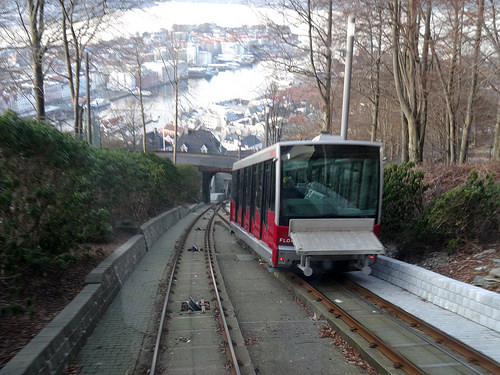
The Funicular Railway at Bergen

Meanwhile, on the wireless, Annika has maintained her status as Queen of the Boat Patrol and leading light of the Oslo Murder Squad. Like Steinar – and despite or because of her idiosyncratic approach to detective work, her problems with heights, confined spaces and her father – she remains a mensch. This is part of her enduring appeal.

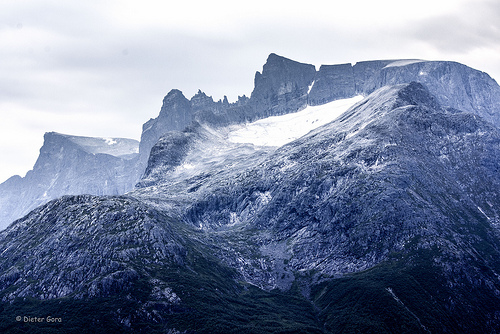
Trolltindene
Trolltindene

So what to say about Annika Stranded (Series 3) which hasn’t been said about the two previous series? Writer Nick Walker and Nicola Walker as Annika are once more at the top of their games. Mikel, Annika’s forensic photographer, is just as put-upon and just as inaudible. Jon Calver has done another playful job with the sound design. First Aid Kit and Hildur Guðnadóttir still provide most of the music although, since Series 2, the Söderberg sisters have released a new album, some of which features in Series 3, and Hildur’s haunting cello has added a very dark layer to the atmosphere of Trapped.

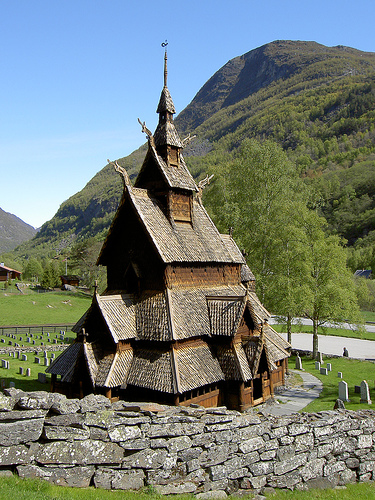
The stave church at Borgund

What is slightly different about Series 3 is that circumstances conspire to take Annika further and further away from her comfort zone of crime on the Oslofjord. The first story, ‘False Signals’ takes place on the island of Ostøya – familiar enough – but the second, ‘Forty Words’, brings her to the naval base in Bergen, and echoes Nick’s earlier, non-Annika drama, Messages To A Submariner. In ‘Traffic’, Annika’s navigational abilities are challenged by spending a lot of time in the boot of a car. The final story, ‘Vertigo’, takes place in the mountains of the Trolltindene, and Annika’s young son Tor shows a flair for church restoration in the stave church at Borgund.

Do not mess with this detective [photo by Jeremy Osborne]
Existentially, the darker moments of Series 3 are perhaps the darkest yet. But they are, in Saul Bellow’s phrase, the dark backing of the mirror, which make Annika’s vitality shine all the brighter.

But unfortunately, Annika never quite starts a relationship with a member of the Reindeer Police …

‘False Signals’, the first of four stories in Annika Stranded (Series 3), is a Sweet Talk production for BBC Radio 4, starting Sunday, 20 November at 7.45 pm and thereafter on BBC iPlayer.

*

Photo Credits

1. Ostøya

photo credit: Espen Klem <a href=”http://www.flickr.com/photos/23874626@N06/5966915563″>IMAG0568</a&gt; via <a href=”http://photopin.com”>photopin</a&gt; <a href=“https://creativecommons.org/licenses/by/2.0/”>(license)</a>

2.Bergen

photo credit: IngolfBLN <a href=”http://www.flickr.com/photos/58927646@N02/24777073882″>Fløibanen Bergen</a> via <a href=”http://photopin.com”>photopin</a&gt; <a href=“https://creativecommons.org/licenses/by-sa/2.0/”>(license)</a>

3.Trolltindene

photo credit: Dieter Gora <a href=”http://www.flickr.com/photos/100571744@N07/14816339785″>Trolltindene</a&gt; via <a href=”http://photopin.com”>photopin</a&gt; <a href=“https://creativecommons.org/licenses/by-nc-sa/2.0/”>(license)</a>

4.Borgund

photo credit: gerdragon <a href=”http://www.flickr.com/photos/77166813@N00/153603937″>Borgund Stave Church</a> via <a href=”http://photopin.com”>photopin</a&gt; <a href=”https://creativecommons.org/licenses/by-nc-nd/2.0/”>(license)</a&gt;


Motherhood Becomes Her … Sort Of: Annika Stranded Series 2

At the end of series one, Annika Strandhed – the queen of the Oslofjord – was going through the gears on her speedboat and promising her child-in-the-womb a lot of fun. Since then she’s given birth to a little boy, named Tor. And now, after an erratic spell of maternity leave, Detective Annika Strandhed of the Oslo Police is back on the case. And so, although he doesn’t know it yet, is little Tor.

Annika Strandhed, aka Nicola Walker

I’ll leave you to judge if Annika is permanently altered by motherhood or suffering from temporary bewilderment and broken nights. Certainly, she’s less inclined to accuse a victim’s father than in the previous series, though whether this is because she’s worked through her own father-issues or put them on the back-burner (see bewilderment and broken nights) is anyone’s guess. What hasn’t changed is the brio with which she approaches her work. Annika’s sidekick, police photographer Mikel (who has become one of the great non-speaking radio characters, right up there with Pru Forrest from The Archers or Samantha from I’m Sorry I Haven’t A Clue) is even more put-upon and long-suffering than before. And, as with Eric Morecambe’s interpretation of Grieg’s Piano Concerto, Annika still tends to play out all the right notes of a case, but not necessarily in the right order.

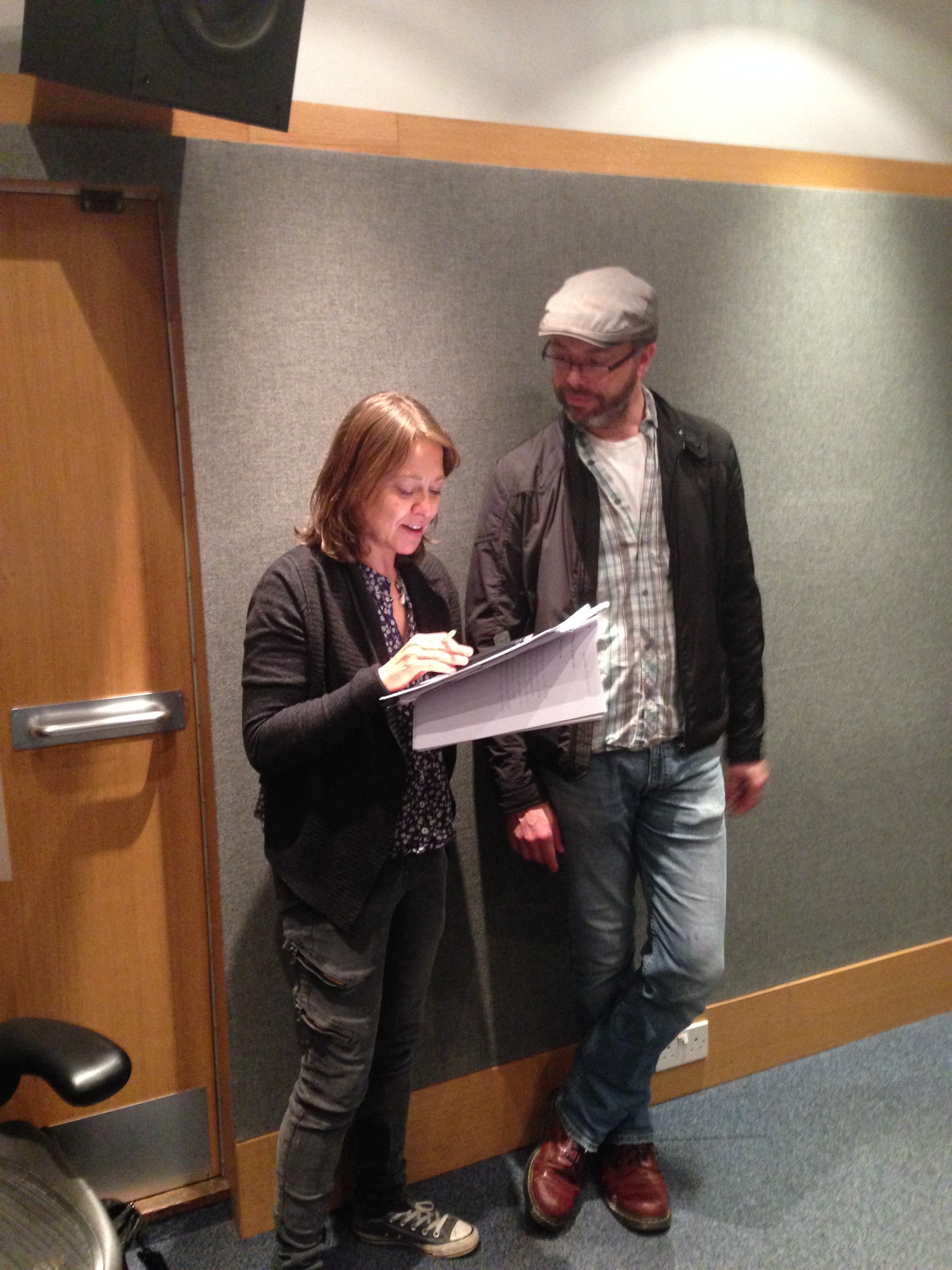
Stranded in the studio - Nicola and Nick
Stranded in the studio – Nicola and Nick

Once again, Nick Walker has created not just a wonderful character but an entire precinct drama in three short stories/mini-plays. And as before Nicola Walker is at the top of her game, to the extent that I suspect that Annika might be playing Nicola, not the other way around.

You can find out how Annika juggles single motherhood and police work by listening to Into The Ice, the first episode of Annika Stranded [Series 2] on BBC Radio 4 at 7.45 pm (BST), Sunday 6 July. And if you’d like to hear a taster of what the three episodes have in store, click here.

Annika Stranded

She doesn’t – as far as we know – have a sartorial trademark like leather trousers or a Faroe jumper. But she’s a fisherman’s daughter, with a passion for driving motor boats at high speed, so maybe state-of-the-art Scandinavian waterproofs figure somewhere. And in moments of high stress, when Sarah Lund might jump into her car without explanation, when Saga Norén might make a factually correct and emotionally clueless remark, Annika Strandhed of the Oslo murder squad is more likely to crack a joke. Trouble is, her colleagues seldom think she’s funny …

But instead of me telling the whole thing, badly, far better to listen to Annika Stranded (click here for BBC link) on Radio 4, 7.45 pm for the next three Sundays.

© Nick Walker
© Nick Walker

For some in the UK the Scandinavian crime ‘bubble’ has already burst – ‘it isn’t great and actually it’s just boring’ – but this isn’t a view I share. For one thing, I don’t think it’s a bubble. Granted, fewer lucky journalists are likely to be dispatched to Copenhagen to have coffee with the likes of Sofie Gråbøl in future, but that’s because Scandinavian crime drama has settled down to take its murky place in our everyday viewing culture, just as American crime has for decades. And for another thing, I’m a fan, a junkie even. No, I haven’t read much (although I did enjoy Henning Mankell’s The Dogs Of Riga years ago) but telly’s another matter. Dysfunctional detectives? Beautiful but bleak coastal landscapes? Murky warehouses? Wood-panelled interiors? Subtitles? Bring them on …

So when Annika-writer Nick Walker suggested his singular take on the genre, he was pushing at an open door.

The Two Walkers

They’re not related, they’re not one and the same person, but I suspect they are symbiotic in some way. The first thing to know about Nick Walker is that more people should know about Nick Walker. He has written two novels – Blackbox and Helloland – but most of his energy is directed towards radio and theatre work. Because of this, I can’t point you towards his back-catalogue in the same way as with a novelist, and can only hope you’ve caught up with some of his wonderful works on BBC Radio in recent years. To name but a few: the recent play Stormchasers  (broadcast over Christmas), the poignant and inventive Messages To A Submariner, and the First King Of Mars stories (voiced first by Peter Capaldi and later, by Dave Lamb.)

Fans of Spooks, and lately, Last Tango In Halifax, will need no introduction to Nicola Walker. TV casting has tended to put her in victim or generally-put-upon roles – and since Nicola is good in all she does it’s a safe bet – but radio has so far provided more scope to show how warm, versatile and funny she is. In Annika Stranded she is all these things, and inhabits the character so completely that it would be easy to believe she’d written the stories herself.

As luck would have it, a previous ‘Nick-ola Walker’ production, Lifecoach, is repeating on Radio 4 on 7 February. I’ll post the link when it becomes available.

Noises On

The classic approach to a radio story is ‘less-is-more’: a reader, a story and at most a little ‘top and tail’ music, putting as little as possible between story and listener. And this still works best with most stories. But Annika Stranded is effectively a series of mini-dramas – performed as such – so it needed something more. Nicola was recorded in studio – neither time nor budget permitted going to Norway – but Nick collected some very good wild-track when he went to Oslo for research. So most of what you hear in the background is authentic Oslo noise. And there’s music from Swedish duo First Aid Kit and some haunting cello from Icelandic musician Hildur Guðnadóttir, too.

This is an unashamedly biased piece. I hope that if you listen to Annika Stranded you enjoy it as much as I do. And as always, thanks for reading.