Sounds Of Silence

A few months ago I bought a new toy, a pocket-sized audio recorder which takes up about the same amount of room as a glasses-case. In the right hands it captures broadcast-quality sound but to develop those hands demands both trial and error. My new and growing sounds library is a diary of both. “Gallery Café, British Museum” was a minor success but “Upper Tooting Road, Olympic Torch” was a failure, partly because I was way too discreet – the sounds were flattened by too many bodies in front of the mike. But at least I came home with something to listen to, which puts it ahead of “Daughter singing solo in end of Year 6 show”, a recording that cut out before she’d even filled her lungs because unwittingly I hit the pause button.

But I’m making progress. Last week, for the first time, I went out with the recorder with serious programme-making intent. I captured the silence of a parish church, by which I mean the ‘hiss’ of the building and the low rumble of the wind outside in the trees and against the brickwork. It worked well enough, but effects like ‘footsteps’ need more practice. I imagine my ‘walker’ now with a shorter, quicker step than my own and need to work out what type of soles and heels she would have worn.

So, while the recorder sat on a tripod atop a grand piano, capturing the silence, I sat in the front pew – conductor and audience for my own private recital of 4’33”. I’m not likely to put this or any of his noisier pieces on my iPod, but I think John Cage was hard done by the knee-jerk “he’s on drugs/having a laugh/what’s the point of that then?” reactions to this ‘piece’. If you want to – and you know it won’t take long – have a look at these performances from 1952 and especially a ‘full orchestral’ version from 2004. Yeah, I know, a conductor directing three ‘silent’ movements looks silly, but try to get past this and remember that the piece was framed by ‘actual’ music in the concert programme. My guess is that the audience probably listened more intensely to 4’33” than to anything else they heard that night.

One of the first things you learn when you edit for radio is that any pauses you want to add must be found somewhere in your recording session. The ‘silence’ in even the best studios is quantifiably different to a couple of seconds of ‘nothing’ from the software menu. It’s not that there’s no such thing as silence, more that silence is relative,  and that the total absence of noise isn’t silence at all, it’s the void.

The Silent History

The first of October saw the launch of an unusual ‘App novel’ (for iPhone and iPad only, at present.) The Silent History is the work of Eli Horowitz, Matt Derby, Kevin Moffett and Russell Quinn: a futuristic narrative covering the years 2011 to 2043 in which increasing numbers of children are diagnosed as ‘silent’, unable to ‘generate or comprehend language of any kind.’ As a concerned citizen in 2021 puts it: ‘… the thing that no one wants to say is, they aren’t like other kids. They lack some basics. They’re not just different, they’re … uncharted.’

For more detail, and it’s worth having, go to the project’s classy website above and also read my friend Melissa Lee-Houghton‘s blog on the subject. In brief: the main ‘novel’ is released via daily instalments to your device, but you can also chart the spread and development of ‘the silents’ via a system of location-specific ‘field reports’, written by other contributors. When your present location matches a field report, you can read it. Not surprisingly, most of the field reports so far are to be found in the U.S., but the fictional silent condition is spreading across the UK and Europe. As no one so far has covered the spread of the silence to Tooting, I’ve not yet read any field reports ‘live’. But I have privately, and found that not only did they work in their own terms but that the spreading of the tale into more familiar idioms and geography was both moving and unsettling. As I understand it, more field reports from more places are still coming in.

For me, this is what’s most exciting about this project: it’s not just an interesting and beautifully-designed e-novel, but an evolving ‘fiction organism’. The Silent History is genuinely pioneering and the writing, which remains the most important thing, has been top notch so far.

Hello darkness, my old friend

It’s been nearly a year since the previous geezer post which, on re-reading, I see prefigured a descent into a long and unhelpful winter gloom with a silence of its own. Don’t want to go there again. So did I make good everything I identified then as wrong? Did I heck. The fags and booze still need to be faced down. But on the plus side, I pay a bit more attention to diet now and although it’s been stop and start I’m into week 5 of Couch to 5K.

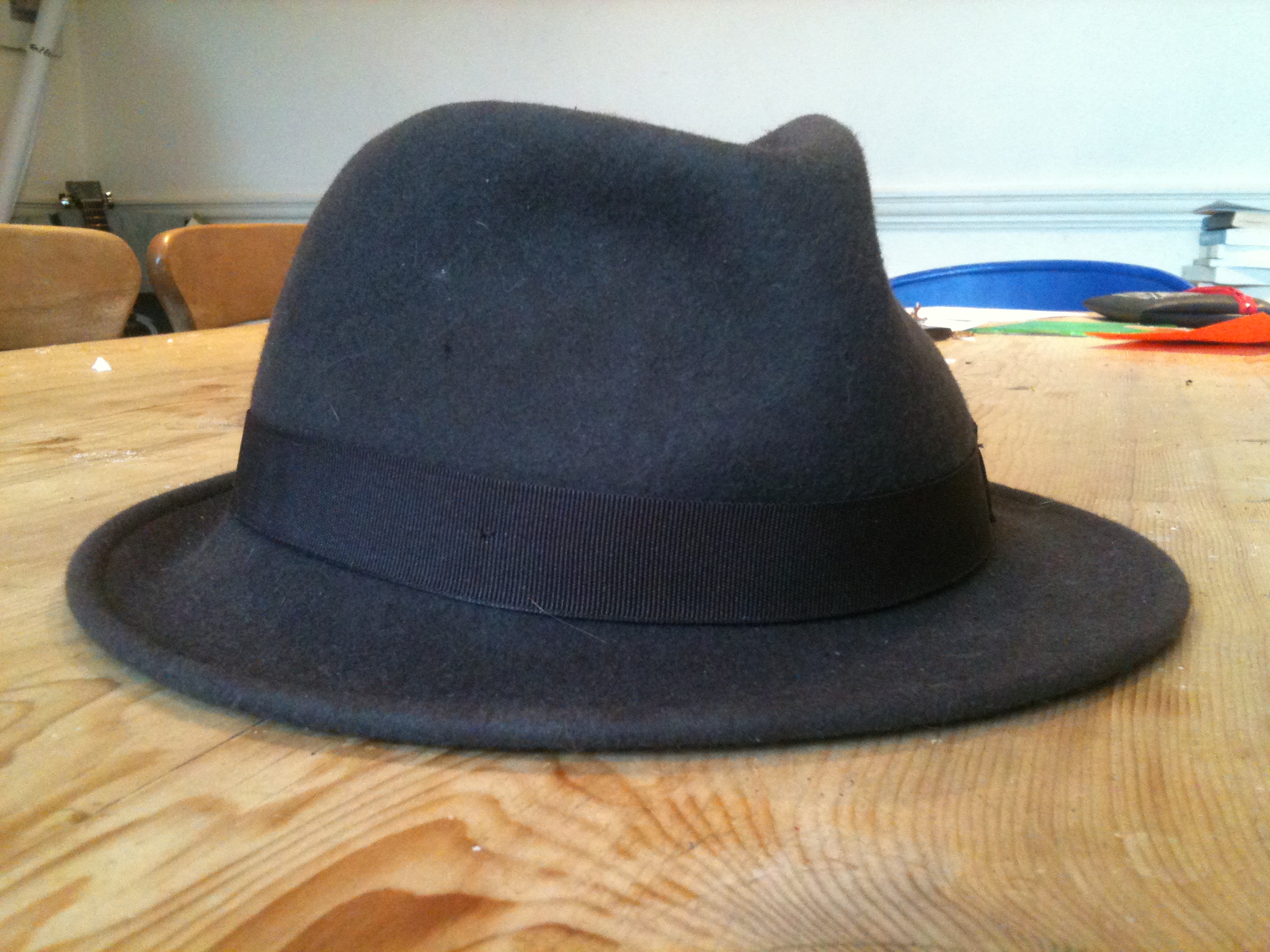
And in the end I bought not one but two new hats:


On the left, a fedora for winter and rain purchased in Spitalfields just before Christmas, and on the right a summer titfer from a market stall in Verona. There’s no denying that the straw hat has a certain ‘Englishman abroad’ quality to it but definitely a step up from a handkerchief with the four corners knotted.

Unfortunately, it’ll be a while before I need it again. The fedora it is.

Saving Daylight

I woke up this morning, winter blues ringin’ in my head.

I’m not sure if you can be diagnosed formally with Seasonal Affective Disorder, but for years now the pattern of my moods has been textbook. The lethargy and gloom kick in early in November, after which there’s a brief remission in the New Year (connected with a holiday rest and residual false optimism about fresh starts), before they return with renewed menace in February.

According to the NHS website, SAD is most common in young people. This surprised me. I’d always assumed this was something that got worse with age, to do with the ultimate darkness, with mortality … but “that’s all I have to say about that.”

We’ve just had a gloriously sunny and warm October – even though the Diwali lights were already up we were still walking about in summer clothes – and perhaps this is why the turning of the year and clocks has hit me so suddenly and hard. The sense that everything might be futile jingles away in the head, like that crap song on the radio that you hate but can’t stop humming. Though I’ve started wearing it because I like to be dry but hate umbrellas, I’ve become self-conscious about my hat and can no longer wear it with my former insouciance. Psoriasis – which I used to put up with cheerfully until my daughter told me she’d been shunned by one of her schoolfriends because I had patches on my arms – is getting me down. And I’m overweight. Given I’ve mostly been skinny (even emaciated, at times) this has been a massive shock to my sense of self. No wonder I’ve been in denial for so long.

Put it all together and it’s as if I’ve been dragged into the trees on Tooting Common by Mid-Life and his psycho-mate Crisis, and been given such a kicking that although the bruises are real I have no memory of the incident.

So what to do?

Either slide into further decline (tempting) or (better) TAKE STEPS to tackle each problem individually. The first act involved referring to the NHS Direct website, not in the hope of salvation, but as an attempt to focus the mind.

1. Winter Blues

I’ve just bought a jar of Vitamin D to supplement my existing meds. Since exposure to daylight is key, perhaps I should wrap up in duvets and fingerless gloves and work outside on dry days. Some people swear by light therapy, but light boxes are expensive and apparently risk a number of unwelcome side-effects, so I’ll pass on that. The NHS recommends a) more exercise, b) careful attention to diet, c) less alcohol and d) no smoking. It has no published views on listening to music but it might be an idea to remove all traces of Mahler, Richard Strauss, Black Sabbath and Nick Drake (not sure I can do that) from the iPod for a while.

2. Hat Crisis

The NHS has no known views on this. Since my hat is uncool and mis-shapen from the rough-and-tumble of family life and one rain-soaking too many, a possible remedy would be to buy a new one. Hugh Bonneville, I noticed, was sporting a highly covetable titfer on Downton Abbey last week (guilty pleasure). But on balance, I think this is something I just have to ride out.

3. Psoriasis

There is no cure though – as with winter blues – sunlight would help, as can certain emollients and UV light therapy (which apparently risks a number of unwelcome side-effects). Other things that help include a) more exercise, b) careful attention to diet, c) less or no alcohol and d) no smoking.

4. Weight Gain

The NHS Direct website recommends a) more exercise, b) careful attention to diet, c) less or no alcohol and d) no smoking.

5. Mid-Life Crisis

At present, there are no plans for Harleys or hair-transplants. It’s such a vague term there are no obvious cures except dealing with it, but I have it on good authority that a) more exercise, b) careful attention to diet, c) less or no alcohol and d) no smoking would probably help.

Unfortunately, it’s all pointing one way: I have to clean up my act.

One of my favourite songs is Roadrunner by Jonathan Richman. Last week, someone gave me a recording of a rare, live version, Roadrunner (Thrice). It’s twice as long as the other versions and allows time for a soliloquy on loneliness and for the journey along Route 128 to become truly epic. I ought to listen to it now to cheer myself up. I can’t dream that I’m young, fit and carefree anymore, but it might convince me that winter can still be a source of magic.

It isn’t September 11th yet, but …

Already the re-living and revision and reflection has begun. There was a sad report on Newsnight about ‘long-term’ casualties in New York, those left chronically debilitated or worse by working in the toxic dust around Ground Zero in the months following the attack. Pankaj Mishra’s authoritative overview in the Guardian – Our own, low, dishonest decade – provides among other things a real sense of the appalling human cost world-wide. As the 10th anniversary draws ever closer, the world media and the blogosphere will be filled by those with significant experiences of that day.

So I’ll get mine – which are humdrum, thankfully – out of the way now.

We were blissfully unaware of events until our younger son came home from his first day at nursery. He switched on the TV and instead of Bob the Builder got live, silent coverage of a smoke-cloud. It took a while to work out what was going on, until the BBC went ‘back to the studio’ and then replayed the last spiteful turn of the second plane over and over again.

Thereafter we kept the TV and Radio 5 Live on for the rest of the day. I don’t know how many times we stared at replays of the towers collapsing into themselves.

Next morning I stood in the back garden and wondered at the silence and – though I was probably imagining this – a clearer sky. We lived in Battersea then and the planes passed overhead towards or away from Heathrow. But not that morning. The children’s routines carried on as normal, but I kept the radio on all day. At times 5 Live simply relayed live broadcasts from one the New York stations. In between speculation about further attacks, the whereabouts of Osama Bin Laden (or Dubya, for that matter) and the first of Rudy Giuliani’s briefings, we heard the Coldstreams play ‘The Star Spangled Banner’ at the Changing of the Guard, by order of the Queen.

My eldest brought a friend home with him from school. They built towers with wooden bricks and knocked them down with toy aeroplanes. This palled quickly because of the amount of time it took to rebuild the towers before crashing into them again. Next time I looked into the bedroom they’d built the Pentagon instead, which could be put together again easily and posed the additional challenge of finding the precise angle at which to skim the small metal planes across the carpet. Like everyone else, they were trying to make sense of things.

At the weekend they changed the programme for The Last Night of the Proms. Instead of the usual musical Britfest of the second half, Leonard Slatkin conducted Samuel Barber’s Adagio. Fair enough. The evening finished with the last movement of Beethoven’s Ninth (Ode to Joy and all that), envisaged as an act of universal solidarity and Western cultural defiance. Looking back, this strikes me as melodramatic, but it didn’t then. These were very strange times.

Anthrax and radio days

The planes returned to the skies. Buckingham Palace, Canary Wharf, Centrepoint and the Nat West tower remained intact. Attention turned to other potential forms of terrorist attack: suitcase ‘dirty-bombs’ (survival chances 1 in 3 for Londoners); Sarin gas and anthrax. I’m an anxious soul and I’m not proud to confess that for a while I bought into every type of fear and paranoia going, to the extent that I wondered quietly if we should pack off our children (7, 3 and 6 months old) to live with their granny in Northern Ireland for a while. But even I couldn’t sustain that level of panic forever. I stopped watching the news on TV after a grim-faced Michael Buerk read the evening bulletin with a giant, tabloid ANTHRAX behind him and started listening to The World Tonight instead, which assessed a still frightening and volatile world in a more measured, intelligent and rational way. And I started listening to Radio 3 in the mornings, reasoning that we weren’t under immediate threat – so long as the music played.

KEEP BUGGERING ON

This is my wife’s favourite phrase in times of stress, and was much loved by Churchill. The summer holidays are almost over: at this end best described as ‘low-key’. This brings with it a profound sense of paternal failure and paralysing moments of pre-autumn gloom. But this is a luxury. ‘Back to school’ is in the air and the kids have all got challenges this year (my daughter starts Year 6, middle son is working towards an early GCSE and my eldest is in A-Level and UCAS year.) My wife is filming at the moment. And, complete with ‘new-term’ haircut, I’m back to school too. I’ve found my ‘new voices’ stories and I’m getting ready to record them. And there are future projects to plan for too – which until recently didn’t seem likely.

Nothing for it.

KBO.

Building The Wall

Today, I’ve been listening to Schumann. I don’t know much about him, but he turned to composing after he injured his hand in a self-made device intended to strengthen his fingers, and so destroyed his hopes of being a great performer. (Glenn Gould soaking his hands in boiling water seems quite sensible by comparison.) His wife Clara, meanwhile, was a great piano virtuoso of her time. The ‘1066 and all that’ line is that their marriage was one of musical minds as well as bodies and souls. But I’m guessing that like most married couples they must have fought sometimes. Given Robert’s backstory this leads me to wonder if some of his more difficult compositions were acts of passive-aggression: something along the lines of “OK Clara, get your fingers round THIS.’

Why Schumann? Lately, with anorak panache, I’ve been building up the music library on my laptop so that it’s comprehensive beyond essentials and desert island favourites. So I’ve been picking out and downloading CDs – many of which I’d forgotten I owned. I have quite a lot of classical CDs, many of them acquired at a time when a) I belonged to a music club, b) I was often too lazy either to cancel or return the recording of the month and c) I was quite often depressed. I’m not suggesting the one caused the other. Even if classical music only rarely broke through my self-made clouds, it did quite often shine like sunlight behind them. Looking back, I think there was a form of self-punishment at work: pop music was frivolous, and somewhere along the line I’d forfeited the right either to sing along or shake my thang – such as it is.

I’m not locked in the past, but it’s useful to look backwards sometimes to make sense not only of how things were but how they are. It’s why I think the study of history should be compulsory until 16 minimum. And it’s why – the pragmatic value of filling air time or column inches aside – the media like a good anniversary. Right now things are building towards a major ‘ten years on’ splurge about 9/11. And recently it’s been 20 years since the failed Moscow coup (remember Boris Yeltsin, sober and standing on top of a tank?) and the 50th anniversary of the building of the Berlin Wall.

1961 also marked the release of a long-forgotten board game called GO: The International Travel Game. What’s this got to do with anything? Bear with me.

When we were kids, our great-uncle used to send us a board game every Christmas, and I imagine this is how GO came into the house. If you click on the link above you’ll see this was very much a game of its time: when travel was glamorous, the boat train from Victoria took people to ‘the continent’, and the lucky flying few took airlines called BOAC or BEA and stepped onto the tarmac looking like Marilyn Monroe, Astrud Gilberto or the Beatles. I can’t remember the rules or object of GO or whether we ever played it to a conclusion: perhaps it was one of those games that someone says ‘let’s play’, takes a while to set up and grasp the rules and is soon afterwards abandoned. The point is, in a battleship grey area with an appropriate fault line caused by the fold in the board, there was a place called Berlin. I didn’t know what or where it was then but it sounded creepy. A lifetime obsession was born.

Later came the diet of war films, spy films, spy novels and history books. I was a Cold War kid: and Berlin was the front line. It still sounded creepy, a bit scary and totally compelling.

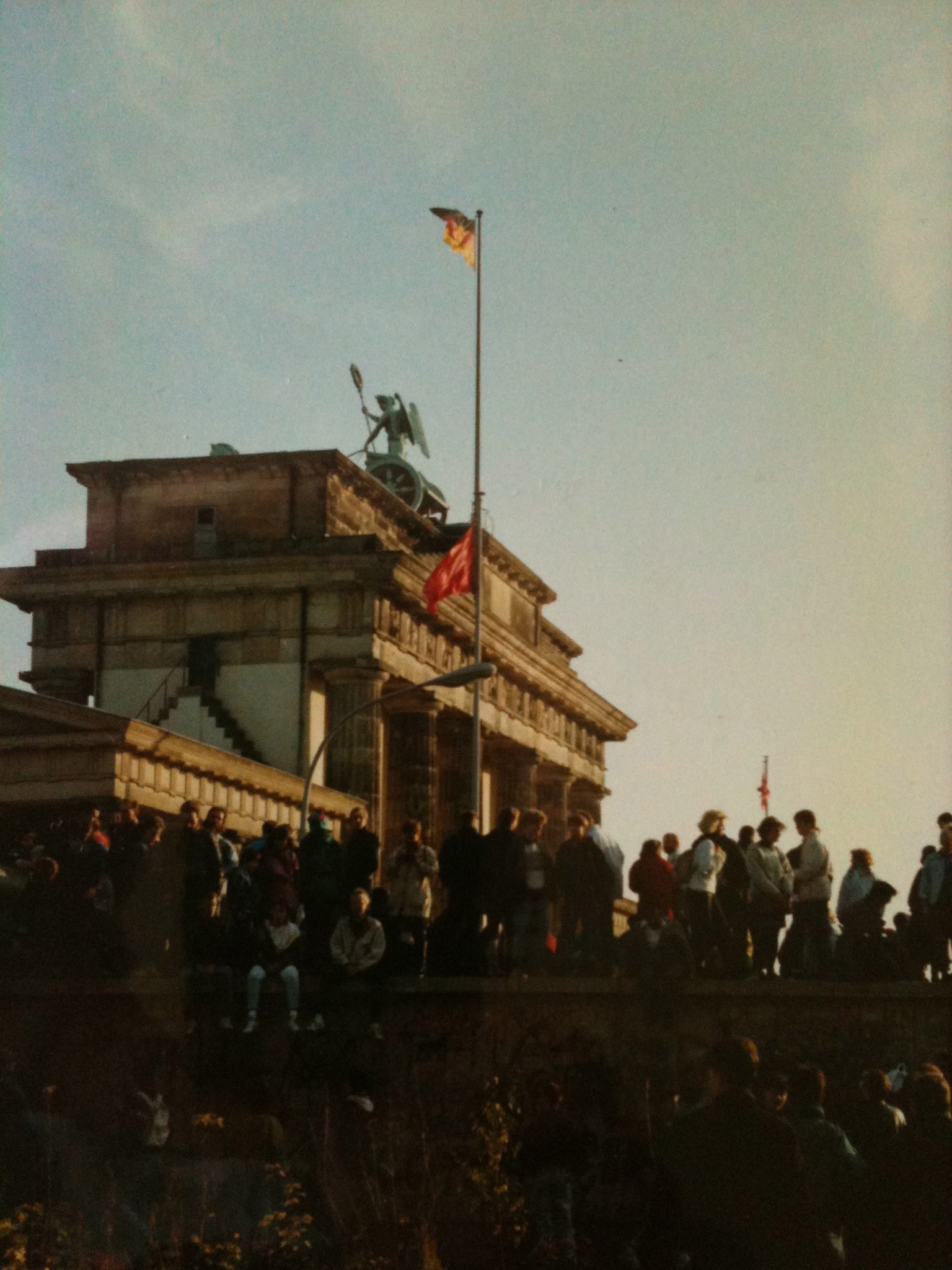
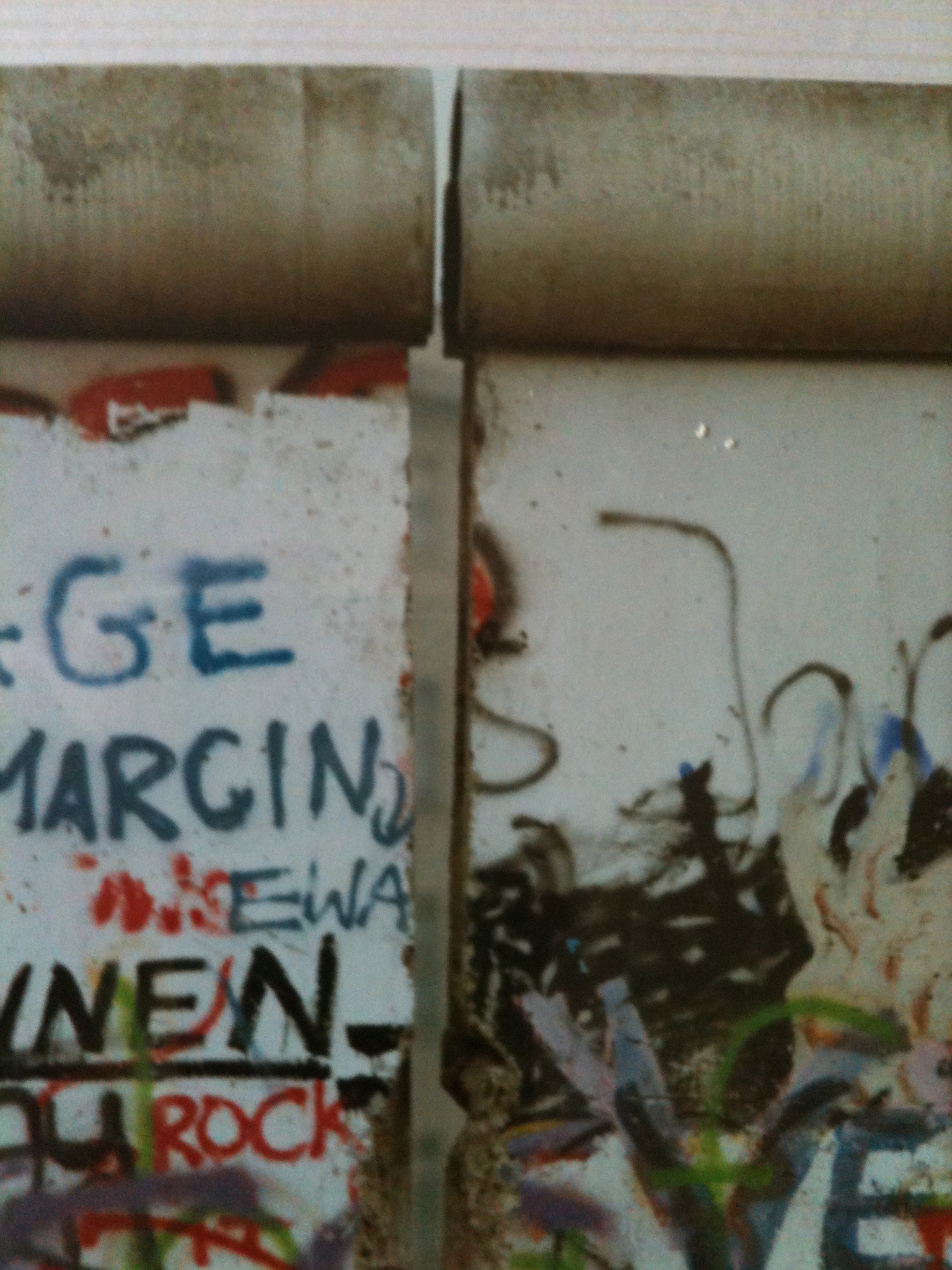
Brandenburg Gate, 10 November 1989
Potsdamer Platz, Sunday 12 November, 1989

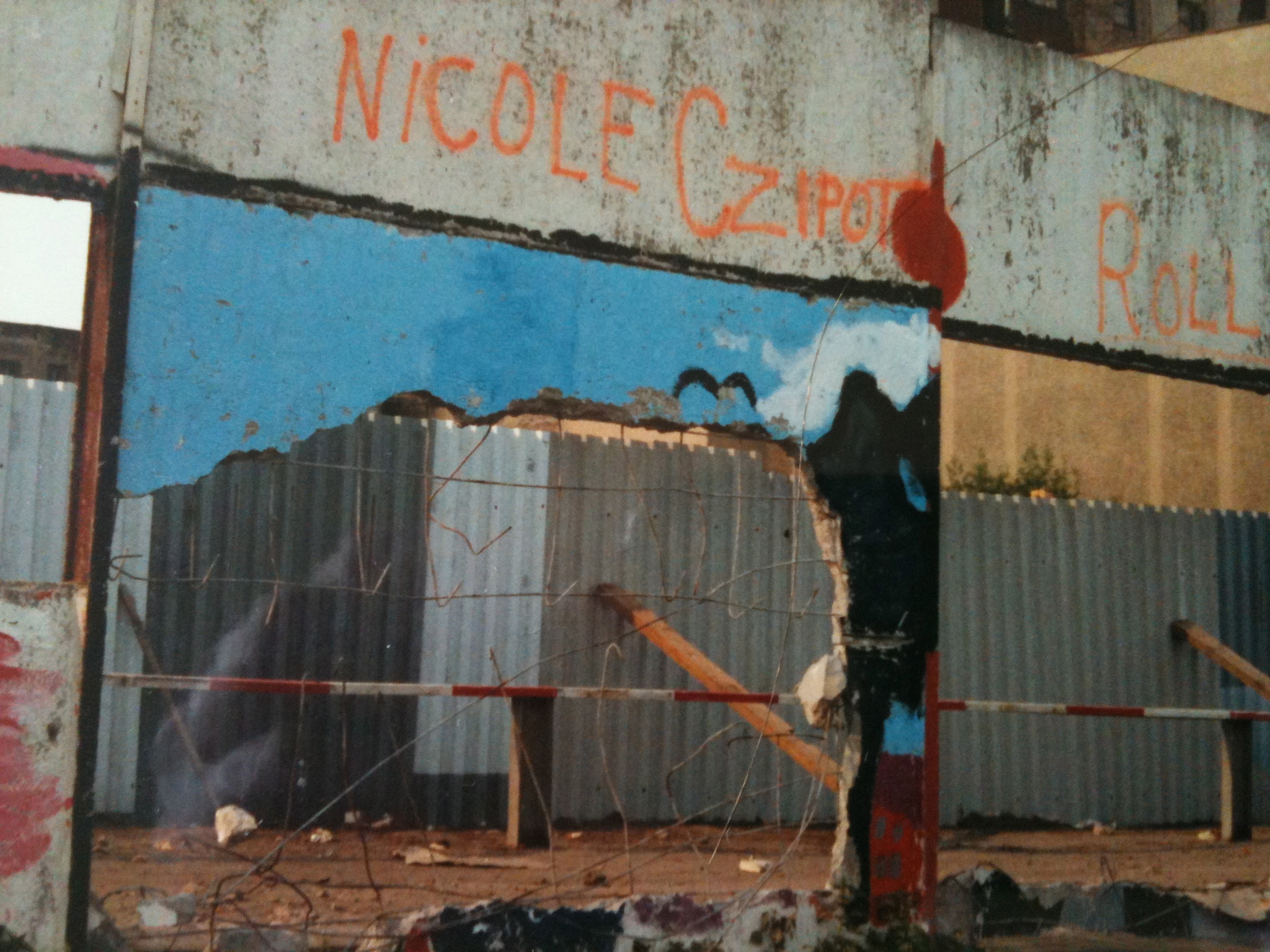
I wasn’t born when they built the Wall but I was in Berlin when they pulled it down. If I stop to describe that weird and wonderful time we’ll be here until spring (another time perhaps). But it was my first trip to the city (my wife, as she wasn’t then, had been before), the GDR opened the border while we were in mid-air, and more than once over the next few days the well-heeled citizens of West Berlin mistook us for ‘Ossies’.

We went back six months later. In some ways this was even weirder. Re-unification was only months away. The Wall was literally disintegrating and bits of it were already being sold on pavements. Rabbits bred and ran rampant over what used to be No Man’s Land. And yet the formalities of the border between the West and the GDR remained. We still had to go through Checkpoint Charlie and buy Ostmarks to go to East Berlin and the Grenzpolizei were just as unfriendly. Elsewhere, unofficial transactions – Ostmarks for Westmarks, Westmarks for Dollars – were conducted through holes in the Wall.

By our next visit, in 1996, the Wall had gone, although you could still trace its path as a gigantic construction site. Berlin was impersonating a boom town, like Chicago in the first wave of skyscraper-building. Huge cranes towered over Potsdamer Platz and work, under floodlights at night, continued round the clock.

Friends of ours relocated to Berlin in 2002, since when we’ve been back a number of times. The first time we went to see them was a magical, cold Christmas when we walked on frozen lakes. You could still work out which side of the Wall you were on by looking at the traffic crossings: the iconic Ampelmann (a geezer in a hat if ever there was one) in the East, more prosaic red and green men in the West. Now, the Ampelmann – himself 50 years old in October – helps Berliners cross the road in all parts of the city.

Now that history has closed over the Wall, physically at least, its original construction seems even more strange and cruel. The Story of Berlin, an interactive museum on the  Kurfürstendamm, evokes the moment with large screens playing footage of those initial hours on continuous loop. It’s very moving: Berliners on both sides transfixed with a mixture of fear, grief and bewilderment as the barbed wire is unrolled across the middle of streets and tram routes. It’s like waking up one morning to discover the borough council’s building department has gone completely insane. I can’t find the same footage on youTube, but if you click on the link, this short US propaganda film gives you some idea of the spirit of that sad, historic time.

In The Shadow Of The Castle

There are no castles in Tooting Bec.

I suppose the most substantial building in my nano-quarter of the universe is St Anselm’s Church. Twice daily, its bells ring out the Angelus and give me an informal time-check. I like this. I can shut my eyes and pretend to be in Italy, and it beats the pips on Radio 4 every time. The bells are heard better from the garden than from the street, where so often the traffic drowns them out.

St Anselm's Church, Tooting

One of the great scholars of his time, Anselm was abbot of Bec, and after the Norman Conquest the Abbey was given the land around Totinges, as Tooting is listed in the Domesday Book. Like Lanfranc before him, Anselm made the cross-channel journey from Bec to Canterbury, and succeeded him as Archbishop in 1093. I don’t know if any miracles were worked through him, but seventy years later Thomas à Becket proposed Anselm for canonization.

Back to The Castle

Enough local history for now. A long time ago, before I became a geezer, I read or misread Kafka like many young men. And probably I identified with Gregor Samsa or Joseph K in some bitter and twisted way. But as I get older, even though I’ve long forgotten the details of the book, it’s the spirit or shadow of The Castle that endures. When they were younger, I suspected that spirit was working through my kids: “[so-and-so] is in The Castle” became shorthand for feeling utterly helpless against the power of illogic, ‘left-fieldness’ and the remorseless, invincible unreason that children are so good at. Lately – in a more classical, Kafkaesque way – I’ve seen the summer evening shadow of The Castle’s battlements make plans for future work less clear. And speaking of work …

I still haven’t read all my stories yet

Because I had other stuff to do, honest. And it’s the school holidays. I’m reading all our ‘New Writing’ submissions on Kindle. Aside from the obvious advantages – portability, not having to print them out or stare at my laptop all day – I hope it will make me a gentler, fairer reader. Since all stories will look the same, I will no longer throw a script across the room enraged by its reader-hostile spacing and text width or passive-aggressive typeface, missing, who knows, a hidden gem in the process. Nor will I be briefly seduced by a story simply because it is laid out with Faber-like authority. What Kindle won’t do is a) read them for me and b) make judgments. Because our submissions come from good sources, there’s a general level of competence which means few stories are weeded out in the first pass: there are no demented ramblings from a confused Satanist in Milton Keynes or archaic prose from a retired colonel in Winchelsea to put aside quickly and quietly. So what do I look for? I only know when I’ve found it. And when I’ve found it, I know. There isn’t a eureka moment, just a sensation of deep peace as I read, possibly tinged with relief. In the end, it’s about finding stories we like and believe we can bring to life on the airwaves. And about voice: the feeling that the story we’re reading or listening to could only be written by this person, warts and all.

This last bit is about cricket

But even here the shadow of The Castle is lengthening across the square. For a number of years now I’ve managed my son’s cricket team. This summer they’ve moved on from junior cricket into the adult game, but there’s one last competition left for us to regroup and challenge for. We’ve progressed serenely through the early rounds, mostly because of a tactical innovation called not playing. Not playing cricket still involves picking a team, planning strategies and batting orders, and the groundsman still prepares a pitch. But on the day of the game your opponents call to say they can’t get a team together and you stand your team down and apologise to the groundsman for his wasted efforts. Then you report the ‘result’ to the organisers, who inform you who you are drawn to play or not play against in the next round. Because of the need to finish the competition before September, no-one is unduly concerned that your progress has been less than triumphant. What matters is the remorseless completion of the cup draw. Playing cricket is but one means to this end – others include the tossing of a coin or, for all I know, playing the opposition coach at bar billiards. I stress that my lads are very good players, and more than capable of getting this far by conventional means. And next week, we will definitely take the field …

Unless it rains. I’m off to find my copy of The Castle now and put it in my kitbag.

Tooting Bec Blues

So here goes. I woke up this morning …

And like Bessie Smith I had an aching head and a space beside me – my wife having long since upped and gone to work. Unlike Bessie, no one could liken me to a ‘bloom in an empty bed’. Coffee sorted the headache while I stared out at a grey summer sky and watched the cat work through his morning psychotic episode, defoliating a clematis and flying through the air at washing on the line like a kung-fu trained Arnold Layne. My daughter came down to start watching Spongebob Squarepants – which gives me the willies. Thus began day 3 of the school holidays.

Fortunately, there are many kinds of blue. I’m delighted that Esi Edugyan‘s novel Half Blood Blues has made the Booker longlist. It was published about a month ago, and since the adaptation we did for radio has now been broadcast, I’m free to enthuse about it as a private citizen. It tells the story of an American-German jazz band in Berlin and Paris during the lead up to war, in particular the fate of the rhythm section – Sid and Chip from Baltimore – and trumpet-prodigy Hieronymus Falk: a German citizen but a mischling, his mother a Rhinelander, his father black African. After the fall of Paris in 1940, Hieronymus is arrested, deported and never seem again. Or so it seems … I won’t say any more about the plot because I hope you’ll read it for yourselves.

A lukewarm, agenda-driven review in The Guardian picked up on Falk’s racial origins and lamented an opportunity missed to engage more directly with Afro-German experience. This isn’t a view I share. Enjoy instead the freshness lent by a Baltimore jazzman’s idiom to well-trodden historical events like Kristallnacht and the ‘Casablanca-moment’ when the Germans march into Paris. Enjoy a tale of love and betrayal with an ‘Amadeus’ twist about genius and mediocrity, narrated by Sid, journeyman bass-player and conflicted, jealous and all-too-human narrator; a walk-on part by Louis Armstrong; all that jazz. Most of all, enjoy all that storytelling.

Time to chase away them Tootin’ Bec blues. The sun is trying to pierce the clouds. The kids need me, I think. And I have a pile of short stories that need reading. But that’s a song for another day.