I’m guessing that lately we’ve all given a little thought to the nature of power.
Some of it – whatever conclusions you’ve drawn – will have focussed not just on global or party politics but sexual politics, too. So you might conclude that Naomi Alderman’s new novel, The Power, couldn’t be more timely. And you’d be right, although to bind this unruly book too tightly to mere events would be to diminish it.
The Power is a historical novel with a difference in that it’s written 5000 years in the future. We meet Roxy, a tough London girl from an underworld family; Tunde, a young Nigerian man who is studying to be a photo-journalist; Allie, a mixed-race girl from Jacksonville whose foster parents use their religion to hide some very dark practices; Margot, an ambitious New England politician and her troubled daughter, Jocelyn.
Their world is much like ours until The Day Of Girls: teenage girls now find they have an electrical power coursing through them – they can harm at will, causing excruciating pain or even death.
This is ‘the power’. And it changes everything.
Beyond this, you’ll have to listen to Book At Bedtime this week and next or read the novel, or better still, do both. Naomi has written an elegant précis on her website and far better to direct you there than regurgitate it clumsily here. Instead, I’m going to say a bit about the challenges of putting The Power on air.
Naomi describes The Power as a piece of ‘feminist science fiction’, which it is, but the first thing to hit us when reading an early proof was that it was a complex and compelling piece of storytelling, for which the old cliché ‘I couldn’t put it down’ was absolutely designed. And it was achieved with a framing device of correspondence between the ‘writer’, Neil Adam Armon (with a letterhead from the Men Writers Association) and another writer, Naomi, who is clearly more established and respected. Neil describes his novel thus: ‘Not quite history, not quite a novel. A sort of ‘novelization’ of what archaeologists agree is the most plausible narrative [… ] I’ve put in some terrifically troubling stuff about Mother Eve . . . but we all know how these things work! Surely no one will be too distressed . . . everyone claims to be an atheist now, anyway. And all the ‘miracles’ really are explicable.’
Who is Mother Eve? You’ll have to listen and/or read to find out.
There were also drawings of archaeological finds from the past. Transcripts of 5000 year old government documents. And a main story told from the points of view of six different characters. Some may describe the narrative as sprawling: I prefer to think of it as multi-dimensional and, as above, ‘unruly’. All the same, it would have been very easy to say ‘I love this book, but I don’t think we can make it work.’
But we couldn’t do that.
So how do you tell this story on radio with only a fifth or sixth of the book to work with? You have to concentrate on the ‘historical novel’: so no Neil, no futuristic Naomi, no drawings (obviously!) nor transcripts. Our version focusses on the stories of Roxy and Allie, with Tunde (the most significant man in the book) often acting as a kind of chorus. Margot and, especially, Jocelyn, have been somewhat short-changed. (This was inevitable, but a pity, as Jocelyn’s story chimes with so many of the pressures of girls/young women – and boys/young men – face today even without electrical powers.)
The next challenge was to find a reader who could not only handle diverse and multiple voices (Nigerian, London, Moldovan, American x 2 …) but Adjoa Andoh has done, I think, a fine job not only with these but in keeping the over-arching, geo-political story together.
Whether our version – and with this book it can only be ‘a version’ – works in its own terms is for the listener to judge.
The Power is both entertaining and wise: so what’s not to like? I’m possibly not a stereotypical man of my age (early fifties) but nevertheless I am one. And I have a fifteen-year-old daughter. Many passages in this book made me look in the mirror and feel uncomfortable in, I hope, a constructive way. I hope that men, many men – not just those who read literary fiction – will encounter this book.
The Power by Naomi Alderman, is on BBC Radio 4, Monday to Friday, 14 – 25 November, 2016. And for 30 days thereafter on BBC iPlayer.
*
Postscript: One of the scenes we’ve omitted involves Margot reacting in an extraordinary way to a bullying and patronising male opponent in a televised gubernatorial debate. I said in my recent post Why I Don’t Blog Anymore … that some subjects didn’t belong in this space. All the same, and I don’t know the correct answer, I can’t help wondering what would have happened if in any of her debates Hillary Clinton had heard, like Margot did, a voice saying: ‘As it is written. “She cuppeth the lightning in her hand. She commandeth it to strike.”‘ and reacted accordingly …
*
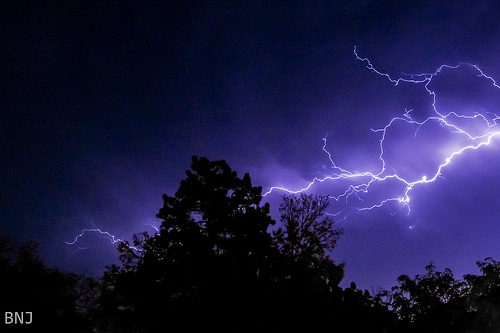
‘Lightning’ photo credit: Brittany N. Johnson <a href=”http://www.flickr.com/photos/133710332@N03/30089631345″>the bolt behind the trees</a> via <a href=”http://photopin.com”>photopin</a> <a href=”https://creativecommons.org/licenses/by-nc-sa/2.0/”>(license)</a>
 geezerinhat