For the last few weeks I’ve been abridging our next Book At Bedtime. There’ll be more details nearer to broadcast but for now, let me tell you that it’s called The Restoration Of Otto Laird, it’s written by Nigel Packer and you can find memory and place on every page like the letters in a stick of rock. Oh, and it made me cry once or twice.
So I’ve been on my bum a lot, staring at a screen, and the recent holiday already seems aeons ago. But I’m still feeling the benefit of all that sun and fresh air, and I haven’t yet forgotten that I enjoy walks (as opposed to runs) as an end in themselves.
Here’s one I took, following a meadow-path downriver:
A rowing eight disappears under the town bridge. It must be years since anyone used the fuel-pumps at the old boat station. I leave behind the cricket and rugby fields, the stunted birch trees and the moored pleasure-boats to reach an open meadow.
Things get more rural (and less Jerome K Jerome) in the next field. Pigs are grazing. The cooling towers of Didcot Power Station come into view. I skirt the barley fields on ploughed up footpaths, pass the 15th century Manor House and cross the river at Culham Lock.
Here a meadow-path leads to the remains of a wartime pill-box, to a small weir and then into the next village. Here I stop to rest in All Saints’ churchyard. It’s peaceful and pretty and so English that the old maids beloved of George Orwell and John Major would lycra up and nick bikes from the Olympic team’s Marginal Gains Unit just to cycle faster to Holy Communion. John Major is still with us, of course, but another former prime minister, Herbert Asquith, rests in this churchyard, as does Eric Arthur Blair himself.
Except this isn’t a walk we took. We were in Barcelona first and then went up into the Pyrenees. I haven’t made the short and gentle journey from Abingdon to Sutton Courtenay for nearly thirty years. Some things have changed, probably, and others I’ve misremembered.
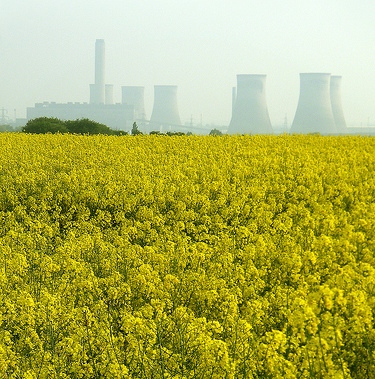
Recently they started blowing up Didcot Power Station. It was a blow to my sense of myself and to begin with made me sad. For Buck Mulligan in Ulysses, it was the Irish Sea; for me, Didcot’s cooling towers were the ‘grey sweet mother’. Only recently did I learn that the power station was a work in progress, still under construction in the 60s and early 70s, and wasn’t the fixed point in a changing world I thought it to be as a child. Visiting home as an undergraduate, the first glimpse from the train window was always special. And the bus from the railway station used to pass close up to the towers, past signs with the slogan ENERGY FOR THE NATION. Even in the early 80s this seemed archaic, a relic of the dying post-war consensus. But enough of that.
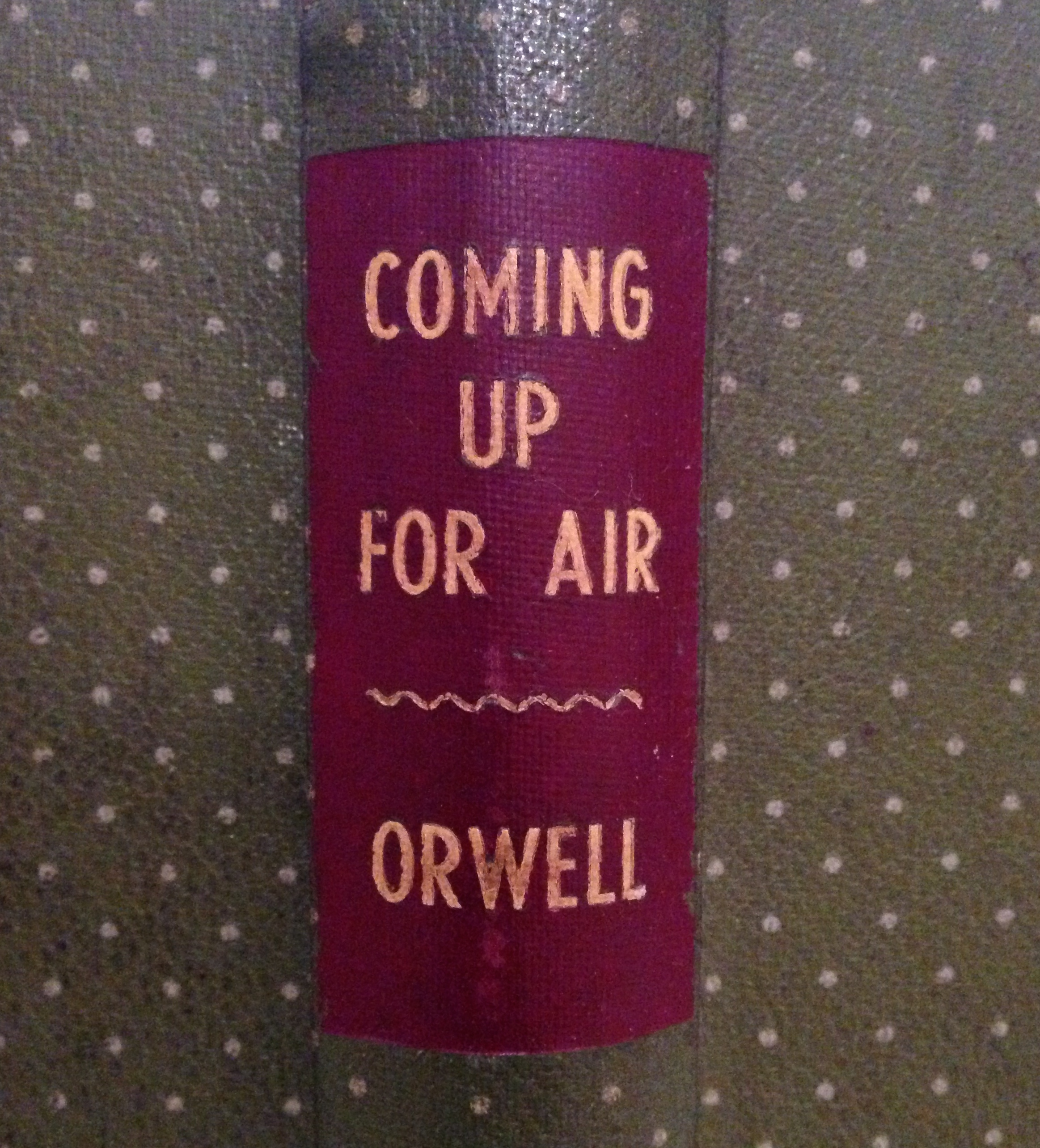 The power station aside, it’s a walk that both Orwell and George Bowling – his mouthpiece in Coming Up For Air – might have related to. Prompted by the sight of primroses on a road side, suburban insurance salesman George Bowling goes ‘missing’ for a few days, escaping to his childhood home, the sleepy Oxfordshire town of Lower Binfield: “… it wasn’t that I wanted to watch my navel. I only wanted to get my nerve back before the bad times begin.”
It’s spring, 1939. Unsurprisingly, Lower Binfield has become a very different place over the last twenty years, and the ‘golden country’ of memory is both tarnished and built-over. George’s last nostalgic reveries are atomised when an RAF bomber on manoeuvres accidentally drops part of its payload on the town.
As a student, I found Coming Up For Air the best of Orwell’s ‘conventional’ novels. It seems much more a period piece now, and while the raps on bombs and rubber-truncheons make for curious reading as a dry run for 1984, it’s all a bit beaten to death with, well, a rubber-truncheon.
For a long time I thought that the gentle walk along my personal stretch of the Thames, from Abingdon to Sutton Courtenay, might be my ‘Lower Binfield’ – the place I might retreat to in preparation for the bad times. There was a time when I imagined retreating there, Bowling-style, to make sense of things if the Cold War was about to turn hot. I’m not sure now. Mountains have enormous appeal -although I still have to press myself against the rocks sometimes to avoid confronting the drop on even the most walker-friendly routes (cf. Angels And Acrophobia, Part Two.) But at least the experience is uncomplicated.
I’ve made several false starts at a post based loosely along these lines over the last eighteen months and no doubt this is all to the good. If I’d written it last year it would surely have been underscored with grief (the death of my father) and/or mid-life gloom or rage (turning fifty). You’ve been reprieved from, among other things, my Proustian encounters with cow-parsley and stinging nettles, and the rediscovery of an album by Ralph McTell. Best of all, you’ve been spared my thoughts on Orwell’s essay Poetry And The Microphone.
 I hope, like Mr Bowling, to remember to notice the primroses next spring. As for Didcot Power Station – sentimental attachment to one side – it was no longer useful, having stopped belching and farting goodness-knows-what into the atmosphere to power the grid – sand God knows it wasn’t beautiful. Removing it with a controlled explosion, when there are so many lethal explosions, controlled and uncontrolled, in the big bad world, really is neither here nor there.
But in its widest sense, I do think energy for the nation could be a good idea.
photo credit: <a href=”https://www.flickr.com/photos/davemorris/478147864/”>Daveybot</a> via <a href=”http://photopin.com”>photopin</a> <a href=”http://creativecommons.org/licenses/by-nc-sa/2.0/”>cc</a>
 geezerinhat