The sixth season of The Time Being, the showcase for ‘new voices’, started on Radio 4 last Sunday evening (19 May). The three stories go out on consecutive Sundays and are available on iPlayer for a week thereafter.
It’s the end of a process that began with 220-plus stories that needed to be read. And to reduce them to three posed a number of challenges. We used very good sources to amplify the call for submissions so the general standard was quite high. This was a good thing, but it meant no shortcuts were available. True, a a few stories were clearly unusable – if only because the sender had ignored our guidelines and criteria – but leaving those aside, none were poor enough to discard after the first paragraph. Every tale deserved a fair hearing.
Then there is the need to maintain the reader’s morale. One of the most interesting things about finding material for each series is to see what themes are preoccupying writers at a given time. Trouble is, if those preoccupations are dark, and you’ve read six or seven tales of similar bleakness in a row, however well told, it can get you down a little. If you sent a story for the series and you’re reading this, let me stress that I’m not having a go at you, as you didn’t write with this particular scenario in mind. It’s just an occupational hazard of the job – my problem, not yours.
Voice is all
Because we issue a set of guidelines and criteria for the submissions, it makes The Time Being sound like a ‘competition’ or prize like the V.S. Pritchett, or Bridport, or Mrs. Joyful (For Rafia Work – of blessed memory.) It isn’t. Ultimately we choose stories that we particularly like and think will work well on air. It so happens that all three stories we’ve recorded this time are first person narratives, but that’s accident, not design. Dramatic monologues can work (but be careful, they are tricky to pull off successfully), so can ‘conventional’ third person omniscience. In the end, what we look for most is voice: the sense that this story, whatever its rough edges, could only be written by this particular writer, and no one else.
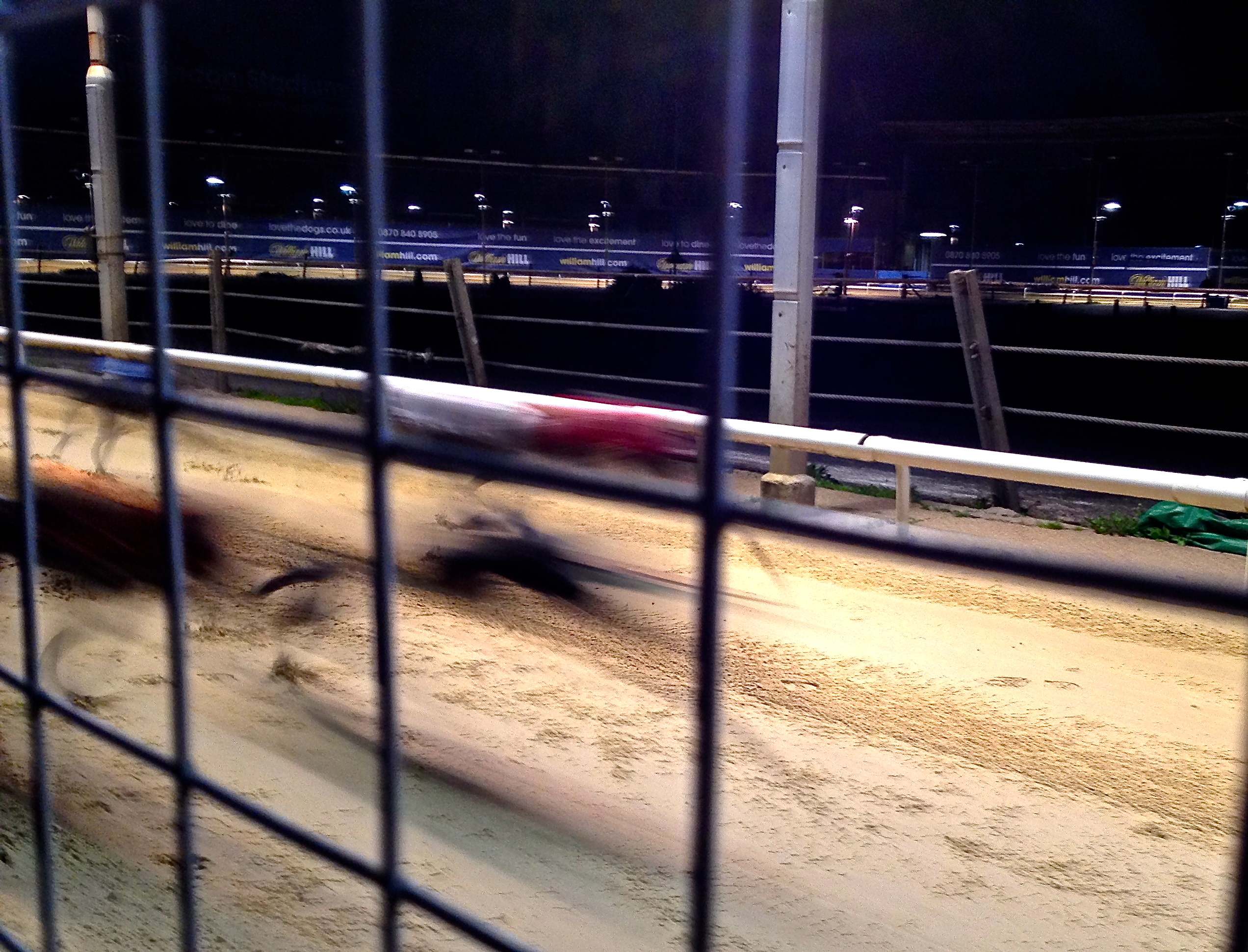
Having said that, there aren’t many rough edges on what I think is a very accomplished set. No spoilers – because I’d rather you listen – but Marathon, by Claire Powell, tells the story of an alcohol-driven extra-marital affair (from the mistress’s point of view) that goes very, very sour when her lover decides to get fit. Llama Sutra, by Melanie Whipman, is even stranger than the title suggests, and even this preview clip – Love In The Time Of Llamas – doesn’t give away quite how strange it is. Rebecca F. John’s The Dog Track tells the story of an unusual and lonely young woman who finds herself alone at the greyhound races, weighing up a matter of life and death. As chance would have it, I was at the dogs at Wimbledon Stadium the day after we recorded the story. We went as a family and enjoyed it hugely, and there were a lot of groups and ‘birthday party’ gatherings there having fun, too. But it did strike me as a very lonely place to be by yourself.
New voices for new voices
I like ‘studio day’: so often it seems more like play than work. It helps that I’m part of a very good and lovely team. And, because each reader brings something with them you might not expect, it’s a collaborative effort. You never end up with a mere ‘aural reproduction’ of the words on the page. And to add to the three writers making their radio debuts, two of the readers were letting their voices loose for the first time on Radio 4. Camilla Marie Beeput, who brings such surprise and warmth to Llama Sutra, is a relative newcomer, for the moment – though not for very much longer – best known for doing the crossword with Yoda in the Vodaphone ad. (Sorry, Camilla!) More surprisingly – for such a good and established screen actress – Marathon is Lorraine Pilkington’s first Radio 4 appearance. If you listen to the story, and hear her beautifully calibrated rendering of the ‘other woman’, who goes from sexy to sad to ever-so-slightly sinister in the space of thirteen minutes, you can only ask: why haven’t you done this before? Similarly, if you listen to Rakie Ayola inhabit a very complex character so completely in The Dog Track, I defy you not to want to hear her more often.
Geezer voices, ever singing …
Speaking of voices, I’m aware that my most recent posts have been driven by ‘events’, and that my own voice, or my blog voice anyway – never strong – has lately been little more than a bat squeak. For the few select fans of more random and pointless geezerposts – I hope to remedy this as soon as headspace permits.
That’s all, for the time being …
 geezerinhat